Banks and the Magic of Finance Class 7 Extra Questions and Answers SST Part 2 Chapter 8
Banks and the Magic of Finance Class 7 Extra Question Answer
Question 1.
What is a share?
Answer:
A share is a unit of ownership in a company, representing a portion of its capital stock. When you buy a share, you become a part- owner of that company.
Question 2.
What is a stock exchange?
Answer:
A stock exchange is a marketplace where financial securities like stocks are traded. The Bombay Stock Exchange, established in 1875, is one of the oldest stock exchanges in the world.
Question 3.
What factors affect share prices?
Answer:
Share prices are affected by company performance and external factors. If a company does well, shares become more .valuable. Government policy changes, wars, and economic shocks also affect prices.
Banks and the Magic of Finance Class 7 Very Short Question Answer
Question 4.
What is a stock market crash?
Answer:
A stock market crash is when the share prices of many companies fall simultaneously. Trading shares can bring gains or losses as their prices fluctuate due to many factors.
Question 5.
How can people prevent financial fraud?
Answer:
People must beware of fraud and scams by not sharing bank details or OTPs through fake calls or messages. In case of fraud, report via helpline 1930 or the National Cybercrime Reporting Portal.
Question 6.
How do banks earn money?
Answer:
Banks pay lower interest rates on savings deposits to depositors and charge higher interest rates on loans to borrowers. This difference in interest rate is their income source.
Extra Questions of Banks and the Magic of Finance Class 7
Question 7.
What was the Pradhan Mantri Jan Dhan Yojana?
Answer:
Pradhan Mantri Jan Dhan Yojana was launched in 2014 to give every Indian, especially low-income earners, access to a bank account with no minimum balance or fees required.
Question 8.
What is the Reserve Bank of India?
Answer:
The Reserve Bank of India is the bank that supervises the Indian banking system. It is also called India’s central bank and has been functioning as banker to banks since 1949.
Question 9.
What does the RBI do?
Answer:
The RBI maintains accounts of other banks, facilitates exchange of funds between banks, provides loans to banks and the government, and sets rules regarding printing currency and fixing benchmark interest rates.
Question 10.
What is a payment system?
Answer:
A payment system is a mechanism that facilitates the clearing and settlement of financial transactions, allowing individuals, businesses, and organisations to transfer funds between each other.
Banks and the Magic of Finance Class 7 Short Question Answer
Question 1.
What is financial infrastructure, and what role does it play in the economy?
Answer:
Financial infrastructure is a network of banks, payment systems, stock markets, and other financial institutions. It helps people, businesses, and the government facilitate financial transactions and manage money.
This infrastructure enables monetary transactions between people and helps fund the development and maintenance of physical infrastructure like roads and railways.
Question 2.
What is a bank, and what are its two main functions?
Answer:
A bank is a financial institution that collects money from people in the form of deposits and lends money to people or borrowers as loans.
Banks help make monetary transactions easy by offering services like saving, withdrawing, and borrowing money. These services are used by farmers, shopkeepers, businesses, and institutions.
Question 3.
What is a savings account, and what are its main features?
Answer:
A savings account is for individuals who save regularly and earn interest on such pavings. It opens with a minimum deposit and allows money to be added or withdrawn. However, there are limits on how often the depositor can withdraw each month. This type of account helps people save money safely.
Question 4.
How does compounding help money grow over time?
Answer:
Compounding means earning interest not just on the original amount but on the amount including interest earned in previous years. For example, if you deposit one thousand rupees at six per cent interest yearly, you earn interest on the growing total each year. This powerful financial concept helps money grow exponentially over time.
Question 5.
How do banks earn money from deposits and loans?
Answer:
Banks pay lower interest rates on savings deposits to depositors and charge higher interest rates on loans to borrowers. This difference in interest rate is a source of income for banks. For example, if a bank pays two per cent on deposits but charges five per cent on loans, it earns the difference.
Question 6.
What was the purpose of the Pradhan Mantri Jan Dhan Yojana launched in 2014?
Answer:
The Pradhan Mantri Jan Dhan Yojana aimed to give every Indian, especially low-income earners, access to a bank account. It required no minimum balance or fees. Since its launch, over fifty crore accounts have been opened, mainly by women, bringing banking services to people from all walks of life.
Question 7.
What is the Reserve Bank of India, and what are its main functions?
Answer:
The Reserve Bank of India is the bank that supervises the Indian banking system. It is also called India’s central bank. The RBI maintains accounts of other banks, facilitates exchange of funds between banks, provides loans to banks and the government, and sets rules regarding printing currency and fixing benchmark interest rates.
Question 8.
What is a cheque and how does it work for transferring money?
Answer:
A cheque is a paper instrument that allows you to pay someone directly from your bank account. To use it, you write the exact amount, the receiver’s name, and your signature. The receiver deposits the cheque in their bank, and the amount gets withdrawn from your account and transferred to their account.
Banks and the Magic of Finance Class 7 Long Question Answer
Question 1.
Explain the three main types of bank accounts and their purposes.
Answer:
The three main types of bank accounts are savings accounts, current accounts, and fixed deposit accounts. Savings accounts are for individuals who save regularly and earn interest, though there are limits on monthly withdrawals. Current accounts are for businesses and traders who often make and receive payments, don’t earn interest, and have no withdrawal limits. Fixed deposit accounts involve a one-time deposit kept for a fixed period, like three or five years, after which the bank returns the original amount plus higher interest than savings accounts offer.
Question 2.
Describe how banks function as intermediaries between depositors and borrowers, using the example of Navdeep and Rima.
Answer:
Banks act as intermediaries by collecting deposits from savers and lending to borrowers. Navdeep saves three thousand rupees monthly from his salary and deposits it in a bank for safety. Rima runs a bamboo products business and needs money for operations. When friends and family couldn’t help sufficiently, she took a loan from the bank. The bank holds Navdeep’s surplus money safely and provides it to Rima as a loan, which she repays later. This system helps both savers and borrowers meet their financial needs efficiently.
Question 3.
How has UPI transformed digital payments in India, and what was the situation before its launch?
Answer:
Before UPI’s launch in 2016, transferring funds required filling out cheques with the receiver’s details and submitting them to banks, which was time-consuming and discouraged people from using banking services. This led to heavy reliance on cash, with billions of rupees used daily without records. The National Payments Corporation of India launched UPI as a fa$t and secure digital payment system. It allows effortless transactions using QR codes or phone numbers. During the COVID-19 pandemic, UPI gained popularity for supporting cashless transactions, and its user-friendly multilingual design makes it accessible to everyone.
Question 4
What are the benefits of the Pradhan Mantri Jan Dhan Yojana for different sections of Indian society?
Answer:
Before 2014, only fifteen crore Indians had bank accounts. The Pradhan Mantri Jan Dhan Yojana aimed to give every Indian, especially low-income earners, access to bank accounts with no minimum balance or fees. Since then, over fifty crore accounts have been opened, mainly by women. The benefits include farmers borrowing money to start businesses or expand agriculture, workers receiving wages directly, and students receiving scholarships directly into accounts. Direct transfers have reduced middlemen and ensure the timely disbursement of funds, bringing banking services to all walks of life.
Question 5.
Explain what shares are and how the stock market functions as a platform for buying and selling them.
Answer:
A share is a unit of ownership in a company, representing a portion of its capital stock. When you buy a share, you become a part- owner due to your investment. The more shares you own, the higher your ownership. The actual buying and selling of shares takes place at the stock exchange, a marketplace where financial securities are traded. In India, the Bombay Stock Exchange was established in 1875. Initially, share transactions were conducted manually using paper tickets, but modern exchanges use digital transactions with advanced computers. Share prices rise j and fall due to various factors.
Banks and the Magic of Finance Class 7 Source/Case Based Questions
1. Read the following extract and answer the questions that follow:
A cheque is a paper instrument that'allows you to pay someone directly from your bank account. The bank provides a cheque book with multiple cheques. To pay ?5,000 to your friend Rohan, you write a cheque with the exact amount, Rohan’s name, and your signature. Rohan can then deposit the cheque in his bank. The amount gets withdrawn (debited) from your account and is transferred (credited) to Rohan’s bank account. The transfer or payment of money through a cheque requires physically visiting a bank and takes time. However, electronic modes of payment allow instant transfers from the sender’s account to the receiver’s account. These are called electronic payment methods.
Question (i).
How cheque is convenient way of paying?
(a) easy to carry cheque
(b) pay directly from bank account
(c) Both (a) and (b)
(d) None of above
Answer:
(c) Both (a) and (b)
Question (ii).
What is important to write on a cheque?
(a) Payer signature
(b) Receiver’s name
(c) Exact amount
(d) All of above
Answer:
(d) All of above
Question (iii).
How does receiver gets the amount?
(a) Amount gets transfered
(b) Bank staff pays
(c) Payer pays
(d) Both (b) and (c)
Answer:
(a) Amount gets transfered
Question (iv).
What are the electronic payment’s method?
Answer:
The transfer or payment of money through a cheque requires physically visiting a bank and takes time. However, electronic modes of payment allow instant transfers from the sender’s account to the receiver’s account. These are called electronic payment methods.
2. Read the following extract and answer the questions that follow:
Rohan buys groceries worth ₹ 700 from a store. She pays through UPI. The next day, she receives a message saying she has won a “special cashback reward.” The message asks her to click a link and enter her bank details to receive the money. Rohan is unsure if this message is real.
Question (i).
Why should Rohan be careful about this message?
Answer:
Rohan should be careful because fraudsters often send fake reward messages to trick people into revealing personal or banking information.
Question (ii).
What steps should Rohan take to stay safe?
Answer:
Rohan should avoid clicking the link, delete the message and report it to the 1930 helpline if needed.
Question (iii).
Why do digital payments require cyber safety?
Answer:
Digital payments involve " sensitive information such as bank account details and passwords. If this information is not protected, fraudsters can misuse it to steal money or commit identity theft.
Banks and the Magic of Finance Class 7 Picture Based Questions
I. Study the picture given below carefully and answer the following questions :
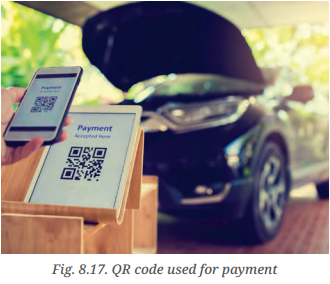
Question 1.
Which type of payment method can you see?
(a) Debit card
(b) Internet banking
(c) UPI
(d) ATM’s
Answer:
(c) UPI
Question 2.
Why this method is so popular?
(a) Easy way
(b) Fast way
(c) Saves time
(d) All of above
Answer:
(d) All of above
Question 3.
What is full form of UPI? Write its two benefits.
Ans
The full form of UPI is Unified Payments Interface payment system. It is benefits are as follows :
- It reduces the need for physical passbook updates.
- It allows users to check balances and track transactions anytime on their phone.
Class 7 Banks and the Magic of Finance Extra Questions for Practice
MCQs
Question 1.
The RBI plays an important role in India’s financial system because it:
a) repairs ATMs in the country
b) controls and supervises all banks
c) decides the price of products in markets
d) issues driving licences
Question 2.
Digital fraud can occur when:
a) we share our OTP or click on unknown links
b) we use official banking apps only
c) we visit a bank branch physically
d) we deposit money in a savings account
Question 3.
People prefer keeping their money in banks because:
a) it earns interest and remains safe
b) banks allow people to watch movies
c) banks provide free shopping facilities
d) money grows without any record
Very Short Answer Type Questions
Question 1.
What is a deposit?
Question 2.
What is a debit card used for?
Question 3.
What is meant by digital bankings?
Question 4.
What is a share?
Short Answer Type Questions
Question 1.
Explain any two advantages of UPI payments.
Question 2.
How do banks earn profit?
Question 3.
Why is financial safety important in today’s world?
Long Answer Type Questions
Question 1.
Describe any three important functions of banks and explain how they help people in daily life.
Question 2.
Explain the importance of digital payments and discuss any two challenges related to them.
Class 7 SST Extra Questions
More from Class 7
- Infrastructure: Engine of India’s Development Class 7 Extra Questions and Answers SST Part 2 Chapter 7
- The State, the Government, and You Class 7 Extra Questions and Answers SST Part 2 Chapter 6
- India, a Home to Many Class 7 Extra Questions and Answers SST Part 2 Chapter 5
- Turning Tides: 11th and 12th Centuries Class 7 Extra Questions and Answers SST Part 2 Chapter 4
- Empires and Kingdoms: 6th to 10th Centuries Class 7 Extra Questions and Answers SST Part 2 Chapter 3
- India and Her Neighbours Class 7 Extra Questions and Answers SST Part 2 Chapter 2
More in Social Science
- Infrastructure: Engine of India’s Development Class 7 Extra Questions and Answers SST Part 2 Chapter 7
- The State, the Government, and You Class 7 Extra Questions and Answers SST Part 2 Chapter 6
- India, a Home to Many Class 7 Extra Questions and Answers SST Part 2 Chapter 5
- Turning Tides: 11th and 12th Centuries Class 7 Extra Questions and Answers SST Part 2 Chapter 4
- Empires and Kingdoms: 6th to 10th Centuries Class 7 Extra Questions and Answers SST Part 2 Chapter 3
- India and Her Neighbours Class 7 Extra Questions and Answers SST Part 2 Chapter 2