India, a Home to Many Class 7 Extra Questions and Answers SST Part 2 Chapter 5
India, a Home to Many Class 7 Extra Question Answer
Question 1.
Who are Jews, and what religion are they traditionally linked to?
Answer:
Jews are members of a people and cultural community originating from ancient Hebrews of Israel. They are traditionally linked to the religion of Judaism.
Question 2.
Where did the Bene Israel Jewish community settle in India?
Answer:
The Bene Israel settled on the Konkan coast, south of Mumbai. They came around 175 BCE when their ship was shipwrecked near the Indian coast.
Question 3.
What gift did the Raja of Kochi give to the Cochin Jews?
Answer:
The Raja of Kochi granted the Cochin Jews land free of cost “as long as the world, sun, and moon endure” so they could settle.
India, a Home to Many Class 7 Very Short Question Answer
Question 4.
What did Swami Vivekananda say about India at the World Parliament of Religions in 1893?
Answer:
Swami Vivekananda said he was proud to belong to a nation which has sheltered the persecuted and refugees of all religions and nations of the Earth.
Question 5.
Why did Syriac Christians face difficulties in West Asia?
Answer:
Under the Roman Empire, Syriac Christians were treated as heretics holding beliefs contrary to dominant views. In the Persian Empire, they faced persecution and violence.
Question 6.
Where did Syriac Christians settle when they came to India?
Answer:
Syriac Christians reached the Malabar coast, which is present-day Kerala, where they could live and worship freely without facing persecution from other empires.
Extra Questions of India, a Home to Many Class 7
Question 7.
Who founded Zoroastrianism, and what is the religion based on?
Answer:
Zoroastrianism was founded by the prophet Zarathushtra in Central Asia. It is based on worship of one God, Ahura Mazda, and . choosing good over evil.
Question 8.
Why did Parsis leave Persia and come to India?
Answer:
Parsis came to escape religious persecution in Persia after the Islamic conquest in the seventh century. They faced forced conversions, religious taxes, and destruction of fire temples.
Question 9.
What does the legend of milk and sugar symbolise about the Parsis?
Answer:
The legend symbolises that just as sugar dissolves in milk and sweetens it without overflowing, Parsis would blend into Indian . society and enrich it without problems.
Question 10.
Where does the ancient Parsi sacred fire continue to burn in India?
Answer:
The ancient sacred fire continues to burn in Udvada in south Gujarat, near where the Parsis first arrived. India has the largest Zoroastrian population today.
Question 11.
Name two similarities between Zoroastrianism and Vedic thought.
Answer:
Both share the concept of a cosmic order holding the universe together. Both also give importance to fire worship in their religious rituals and ceremonies.
Question 12.
When did Arab merchants start coming to India, and what did they trade?
Answer:
Arab merchants came to India from the seventh century onwards. They traded spices and other goods, settling along the west coast in Kerala, Gujarat, and Karnataka.
Question 13.
Who are the Siddis, and how did they come to India?
Answer:
The Siddis are of African origin. They were enslaved in Africa and brought to India as slaves by Arab, Portuguese, and British traders between the seventh and nineteenth centuries.
Question 14.
What is unique about Siddi cultural traditions in India?
Answer:
Their cultural identity represents a fusion of African and Indian traditions. They have distinctive dance accompanied by African- style drumming and integrated African religious practices with Indian religions.
Question 15.
Who was Hirabai Lobi, and what award did she receive?
Answer:
Hirabai Lobi belonged to the Siddi community in Gujarat. She was awarded the Padma Shri in 2023 for working towards the upliftment of women in her community.
Question 16.
What important role did Abdul Hai play during the Mughal period?
Answer:
Abdul Hai, an Armenian, was the Chief Justice in Emperor Akbar’s court. Armenians played important roles in the Mughal royal household, army, and administration during that period.
Question 17.
Where did Armenians build important settlements and structures in India?
Answer:
Armenians settled in Surat, Kolkata, and Chennai. They built schools, churches, and cemeteries. Kolkata became a major Armenian hub with the eighteenth-century Armenian College and Mother Mary Church.
Question 18.
Who founded the Baha’i religion, and what were its core teachings?
Answer:
Baha’i began in Persia in the mid-1800s and was led by Baha’u’llah. His teachings spoke of unity among all people and harmony between different religions worldwide.
Question 19.
Why did Baha’is come to India in the late nineteenth century?
Answer:
The ruling religious leadership in Iran branded them as heretics because of different beliefs. They were persecuted and looked for safer places to live, so they came to India.
Question 20.
How did the Maharaja of Nawanagar help Polish children during World War II?
Answer:
Digvijaysinhji Ranjitsinhji Jadeja mobilised the Red Cross to rescue Polish orphAnswer: He brought them to Jamnagar and saved around 1,000 Polish orphans between 1942 and 1946, providing food and care.
India, a Home to Many Class 7 Short Question Answer
Question 1.
Who are the Bene Israel and when did they arrive in India?
Answer:
The Bene Israel are a Jewish community that lived on the Konkan coast, south of Mumbai. According to scholars, they came around 175 BCE from the ancient Kingdom of Israel. Their ship was shipwrecked near the Indian coast during a storm, and the survivors settled in India and started a new life.
Question 2.
What did the Raja of Kochi grant to the Cochin Jews?
Answer:
The Raja of Kochi granted the Cochin Jews land free of cost “as long as the world, sun, and moon endure.” This allowed them to settle in the region and build a synagogue to practise their faith. The Maharaja of Travancore also gave expensive gifts to the synagogue, showing respect.
Question 3.
What is the legend of milk and sugar about the Parsis?
Answer:
When Parsis approached Raja Jadi Rana of Sanjan, he showed them a full jug of 1 milk, indicating the kingdom could not accommodate more people. A wise Parsi man dissolved sugar in the milk without spilling it, meaning Parsis would blend into Indian society and enrich it without causing problems.
Question 4.
Why did Parsis come to India?
Answer:
Parsis came to escape religious persecution in Persia after the Islamic conquest in the 7th century CE. They faced forced conversions to Islam, religious taxes called jizya, destruction of fire temples, and social and legal marginalisation. Groups of Zoroastrians sailed across the Arabian Sea and reached Gujarat between the 8th and 10th centuries.
Question 5.
Who were the Arab merchants and how did they contribute to India?
Answer:
Arab merchants came to India from the 7th century onward and settled along the west coast in Kerala, Gujarat, and Karnataka. They traded spices and other goods, married local women, and formed new communities. They helped build India’s oldest mosque, the Cheraman Juma Masjid, and contributed to cultural exchange.
Question 6.
Who are the Siddis and how did they come to India?
Answer:
The Siddis are of African origin. They were enslaved in Africa and brought to India as slaves by Arab, Portuguese, and British traders between the 7th and 19th centuries. Their cultural identity represents a fusion of African and Indian traditions, including distinctive dance with African-style drumming and adapted languages.
Question 7.
What roles did Armenians play during the Mughal period?
Answer:
During the Mughal period, Armenians played important roles in the royal household, army, and administration. Abdul Hai was Chief Justice in Akbar’s court, and Lady Juliana was a doctor in the royal palace. Emperor Akbar gave them permission to build a church and follow Christian practices in Agra.
Question 8.
What are the Dalai Lama’s four commitments?
Answer:
The Dalai Lama’s four commitments are: promotion of human values like compassion, forgiveness, and tolerance; promotion of religious harmony; preservation of Tibetan culture; and revival of India’s civilisational heritage, particularly values like karuna, which means compassion, and ahimsa, which means nonviolence. He lives in Dharamshala, Himachal Pradesh.
Question 9.
What is Sowa Rigpa and where is it practised?
Answer:
Sowa Rigpa, also called ‘Art of Healing’, is the Tibetan traditional medicine system. It was codified in the 8th century CE near Lhasa, Tibet, and blends ancient principles of Ayurveda with inputs from China, Central Asia, Persia, and Greece. In India, institutions like Men-Tsee-Khang in Dharamshala practise this system.
Question 10.
What does the phrase “vasudhaiva kutumbakam” mean?
Answer:
“Vasudhaiva kutumbakam” is a Sanskrit phrase that means “the whole world is family.” It expresses the idea of universal brotherhood and fundamental unity of humankind. This is a core civilisational value of India that has been practised for millennia and shows India’s culture of acceptance and inclusion towards all people.
Question 11.
What does the phrase “India, a Home to Many” signify in the context of the country’s diversity?
Answer:
The phrase “India, a Home to Many” signifies the rich cultural, linguistic, and religious diversity that characterises India. It highlights how various communities, traditions, and practices coexist within the nation, making it a unique tapestry of different identities and ways of life.
Question 12.
How does India’s geographical diversity contribute to its cultural variety?
Answer:
India’s geographical diversity, ranging from mountains to plains and coastlines, influences its cultural variety by creating distinct local traditions, cuisines, and lifestyles. Different regions have developed unique customs and practice's that reflect their environment, leading to a rich mosaic of cultures across the country.
Question 13.
What role do festivals play in showcasing India’s diversity?
Answer:
Festivals in India play a crucial role in showcasing the country’s diversity as they celebrate various cultural and religious beliefs. Each festival, whether it is Diwali, Eid, Christmas, or Baisakhi, reflects the unique traditions of different communities, fostering unity and understanding among diverse groups.
Question 14.
Why is linguistic diversity considered an important aspect of India’s identity?
Answer:
Linguistic diversity is an important aspect of India’s identity because it represents the multitude of languages spoken across the country. With numerous languages and dialects, each language carries its own literature, history, and cultural significance, contributing to the overall richness and complexity of Indian heritage.
Question 15.
In what ways do traditional arts and crafts reflect India’s multiculturalism?
Answer:
Traditional arts and crafts in India reflect the country’s multiculturalism by showcasing the skills and creativity of various communities. Each region has its own distinctive art forms, such as Madhubani painting from Bihar or pottery from Rajasthan, which are influenced by local culture and traditions, highlighting the diverse artistic expressions found throughout the nation.
Question 16.
Explain the legend of milk and sugar associated with the arrival of Parsis in India.
Answer:
When Parsis approached Raja Jadi Rana of Sanjan in Gujarat, the Raja showed them a jug full of milk, indicating his kingdom could not accommodate more people. A wise Parsi man dissolved sugar in the milk without spilling it, symbolising that Parsis would blend into Indian society and enrich it without causing problems. The Raja was pleased and granted them a secure place to settle.
Question 17.
Describe Swami Vivekananda’s statement about India’s welcoming nature at the World Parliament of Religions.
Answer:
At the World Parliament of Religions in Chicago in 1893, Swami Vivekananda expressed pride in belonging to a nation that sheltered persecuted people and refugees of all religions and nations. He specifically mentioned that India gave refuge to Israelites when their holy temple was destroyed by Roman tyranny and also sheltered the Zoroastrian nation, highlighting India’s culture of acceptance.
Question 18.
What role did the Maharaja of Nawanagar play during the Second World War?
Answer:
Digvijaysinhji Ranjitsinhji Jadeja, the Maharaja of Nawanagar (present-day Jamnagar), rescued around 1,000 Polish orphans between 1942 and 1946 during the Second World War. He mobilised the Red Cross and other organisations, providing the children with safety, food, and care. He also welcomed several thousand Polish refugees. His humanitarian service was recognised with a monument called ‘Good Maharaja Square’ in Warsaw.
Question 19.
Explain the circumstances that led Tibetan refugees to seek asylum in India.
Answer:
From 1950 onwards, the People’s Republic of China overran Tibet in several waves, eventually annexing it. In 1959, following a popular uprising in Lhasa against Chinese presence, the 14th Dalai Lama fled across the Himalaya and took refuge in India. The Indian government granted him asylum, and he has been living in Dharamshala since then, where the Central Tibetan Administration functions as a government-in-exile.
Question 20.
What is Sowa Rigpa and how has it been integrated into Indian healthcare?
Answer:
Sowa Rigpa, also called ‘Art of Healing’, is the traditional Tibetan medicine system codified in the 8th century CE near Lhasa. It blends ancient Ayurvedic principles with inputs from China, Central Asia, Persia, and Greece. Tibetan refugees propagated it in India after 1959. Institutions like Men- Tsee-Khang in Dharamshala practise this system, and it has been integrated into the Government of India’s AYUSH programme.
India, a Home to Many Class 7 Long Question Answer
Question 1.
Describe how the Maharaja of Nawanagar helped Polish refugees 1 during the Second World War.
Answer:
During the Second World War, Poland was invaded, and thousands of families were ' torn apart, with many children orphaned. Digvijaysinhji Ranjitsinhji Jadeja, the Maharaja of Nawanagar State, was touched by this tragedy. He mobilised the Red Cross and other organisations to rescue.the children. He brought them to Jamnagar and provided a safe place to stay, food, and care. He saved around 1,000 Polish orphans between 1942 and 1946. Several thousand Polish refugees were also welcomed to stay safely in his state. The children returned home safely after the war ended, and his service was recognised by the President of Poland.
Question 2.
How did Swami Vivekananda describe India’s tradition of welcoming refugees at the World Parliament of Religions?
Answer:
At the World Parliament of Religions in Chicago in 1893, Swami Vivekananda said he was proud to belong to a nation which has sheltered the persecuted and refugees of all religions and all nations of the Earth. He specifically mentioned that India gave refuge to the Israelites when their holy temple was destroyed by Roman tyranny. He also mentioned that India sheltered the Zoroastrian nation. His words highlighted India’s long tradition of providing safety and acceptance to people fleeing persecution from various parts of the world, reflecting the country’s cultural values of inclusion and compassion towards all communities.
Question 3.
Explain how Tibetan refugees were rehabilitated in India and why they came here.
Answer:
From 1950 onward, the People’s Republic of China overran Tibet and eventually annexed it. In 1959, following a popular uprising in Lhasa against Chinese presence, the 14th Dalai Lama fled across the Himalaya and took refuge in India. The Indian government granted him asylum and rehabilitated Tibetan refugees by providing education to their children and facilitating the creation of Tibetan settlements to preserve their language, culture, and heritage. Many Tibetan monasteries were established in India, particularly in Karnataka, creating space for Tibetan Buddhists to pursue their spiritual practices without fear. Many NGOs also supported the community with livelihood options.
Question 4.
What are the similarities between Zoroastrianism and Vedic thought mentioned in the content?
Answer:
Zoroastrianism and Vedic thought share several similarities. Both share the concept of a cosmic order holding the universe together, and both give importance to fire worship in rituals. There are similarities in words between the two traditions: Soma, the Vedic divine drink, is similar to Haoma in Avestan; Hotar, the Vedic priest, is similar to Haotar; and Yajna, the Vedic sacrifice, is similar to Yasna. Old Avestan and Vedic Sanskrit share many word roots and grammatical features. However, there are interesting differences, such as devas being beneficial gods in Vedas but evil gods in Avesta.
Question 5.
How did various communities integrate into Indian society whilst maintaining their unique identities?
Answer:
Various communities integrated into Indian society whilst preserving their unique identities through India’s culture of acceptance. The Parsis combined their ancient traditions with local Indian culture, whilst the ancient sacred fire continues to burn in Udvada. Syriac Christians integrated into Indian society whilst maintaining their traditions and are divided into several sects. Siddis adapted their language to regional influences and integrated African religious practices with Hinduism, Islam, or Christianity. Armenians built schools, churches, and cemeteries in cities like Kolkata and Chennai. Indian cultural values like vasudhaiva kutumbakam and atithi devo bhava enabled these communities to find India secure whilst maintaining their traditions over centuries.
India, a Home to Many Class 7 Source/Case Based Questions
1. Read the following extract and answer the questions that follow:
We have a different kind of story with the Siddis. The Siddis are of African origin; enslaved there, they were brought to India as slaves of Arab, Portuguese, and British traders between the 7th and 19th centuries. In the 18th century, some Siddis gained prominence in Muslim rulers’ armies and briefly controlled parts of Bengal. Their cultural identity represents a fusion of African and Indian traditions. The Siddis have a distinctive dance accompanied by African-style drumming. Over time, they have adapted their language to regional influences and integrated African religious practices with adopted faiths of Hinduism, Islam, or Christianity. The Siddis are designated as a scheduled tribe. However, the Siddis’ overall economic condition remains poor and efforts are being made to provide them with better access to education and livelihood options.
Question (i).
Siddis, slaves of Arab are brought to which country?
(a) India
(b) America
(c) Portugese
(d) None of these
Answer:
(a) India
Question (ii).
Their cultural identity represents fusion of which traditions.
(a) African
(b) Indian
(c) Both (a) and (b)
(d) American
Answer:
(c) Both (a) and (b)
Question (iii).
Siddis were designated to which caste group?
(a) Scheduled castes
(b) Scheduled tribe
(c) Bhil
(d) Chamar
Answer:
(b) Scheduled tribe
Question (iv).
Who are Siddis, what areas their economic condition?
Answer:
The Siddis are of African origin overall economic condition remains poor and efforts are being made to provide them with better access to education and livelihood options.
2. Read the following extract and answer the questions that follow:
The earliest such Armenian settlement was in Agra where the Mughal emperor, Akbar, gave them permission to build a church and follow their Christian religious practices. Armenians began to play important roles in the Mughal royal household, the army, as well as the administration during the time of several Mughal emperors. For example, Abdul Hai was Chief Justice in Akbar’s court while Lady Juliana was a doctor in the royal palace. The Armenians also settled in Surat, Kolkata, and Chennai, building schools, churches, and cemeteries, and creating a lasting cultural impact. Kolkata became a major Armenian hub. The 18th-century Armenian College and Mother Mary Church continue to be active. Their story reflects India’s tradition of embracing diverse communities seeking refuge and prosperity.
Question (i).
Where did Armenian build important settlements?
(a) Surat
(b) Kolkata
(c) Chennai
(d) All of above
Answer:
(d) All of above
Question (ii).
Where they settled for 1st time?
(a) Malabar coast
(b) Konkan coast
(c) Coromondel coast
(d) Flat coast
Answer:
(a) Malabar coast
Question (iii).
Where did they build church earliest?
(a) Punjab
(b) Bengal
(c) Agra
(d) Kolkata
Answer:
(c) Agra
Question (iv).
Does Armenian settled in Mughal rule and how ?
Answer:
Yes, they settled in Mughal rule and began . to play important role over there. They play important role in their househod, army as well as the in administration.
India, a Home to Many Class 7 Picture Based Questions
I. Study the picture given below carefully and answer the following questions :
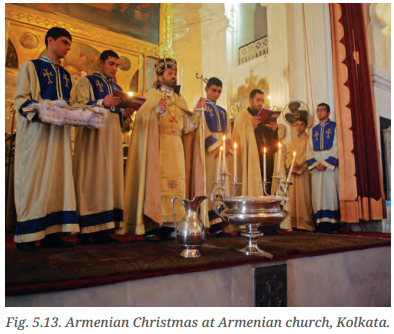
Question 1.
Which church can you see in picture?
(a) Armenian Church, Chennai
(b) Armenian Church, Kolkata
(c) Ethiopian Church
(d) Syriac Church
Answer:
(b) Armenian Church, Kolkata
Question 2.
Which king give the permission to build this church?
(a) Rana
(b) Ashoka
(c) Akbar
(d) Rajaraja chola
Answer:
(c) Akbar
Question 3.
In which other cities does Armenians settled?
(a) Surat
(b) Kolkata
(c) Chennai
(d) All of above
Answer:
(d) All of above
Question 4.
Where does earliest Armenians settled?
Answer:
The earliest Armenians settled in Agra,
where Mughal emperor, Akbar, gave them permission to build a church and follow their Christian religious practices.
Class 7 India, a Home to Many Extra Questions for Practice
MCQs
Question 1.
Why did Arab merchants come to India from early times?
(a) To establish empires
(b) To spread their religion by force
(c) To trade peacefully
(d) To capture ports
Question 2.
Which Muslim community in Kerala traces its origins to Arab traders?
(a) Bohra
(b) Khoja
(c) Mappila
(d) Pathan
Question 3.
From which continent did the Siddis originally come to India?
(a) Europe
(b) Africa
(c) Australia
(d) South America
Question 4.
How did the culture of the Siddis develop over time in India?
(a) It remained completely African
(b) It was fully replaced by Indian culture
(c) It became a mix of African and Indian traditions
(d) It disappeared entirely
Question 5.
How are the Siddis officially recognised by the Indian government today? N-
(a) Minority religion
(b) Scheduled Tribe
(c) Refugees
(d) Nomadic group
Very Short Answer Type Questions
Question 1.
What is the holy fire of the Parsis called?
Question 2.
What is the name of the Mughal emperor who supported the Armenians?
Question 3.
Which port city in Kerala became an important Jewish settlement?
Short Answer Type Questions
Question 1.
Describe the role of Arab traders in the spread of Islam in India.
Question 2.
Explain the significance of Vasudhaiva Kutumbakam in shaping India’s attitude towards migrants.
Question 3.
How did the Polish children reach India during World War II, and who helped them?
Long Answer Type Questions
Question 1.
Discuss the role of kindness and compassion in India’s treatment of refugees with reference to any two communities from the chapter.
Class 7 SST Extra Questions
More from Class 7
- Banks and the Magic of Finance Class 7 Extra Questions and Answers SST Part 2 Chapter 8
- Infrastructure: Engine of India’s Development Class 7 Extra Questions and Answers SST Part 2 Chapter 7
- The State, the Government, and You Class 7 Extra Questions and Answers SST Part 2 Chapter 6
- Turning Tides: 11th and 12th Centuries Class 7 Extra Questions and Answers SST Part 2 Chapter 4
- Empires and Kingdoms: 6th to 10th Centuries Class 7 Extra Questions and Answers SST Part 2 Chapter 3
- India and Her Neighbours Class 7 Extra Questions and Answers SST Part 2 Chapter 2
More in Social Science
- Banks and the Magic of Finance Class 7 Extra Questions and Answers SST Part 2 Chapter 8
- Infrastructure: Engine of India’s Development Class 7 Extra Questions and Answers SST Part 2 Chapter 7
- The State, the Government, and You Class 7 Extra Questions and Answers SST Part 2 Chapter 6
- Turning Tides: 11th and 12th Centuries Class 7 Extra Questions and Answers SST Part 2 Chapter 4
- Empires and Kingdoms: 6th to 10th Centuries Class 7 Extra Questions and Answers SST Part 2 Chapter 3
- India and Her Neighbours Class 7 Extra Questions and Answers SST Part 2 Chapter 2