Turning Tides: 11th and 12th Centuries Class 7 Extra Questions and Answers SST Part 2 Chapter 4
Turning Tides: 11th and 12th Centuries Class 7 Extra Question Answer
Question 1.
What were the outcomes of the two Battles of Tarain?
Answer:
In the First Battle of Tarain in 1191. Prithviraja II defeated Muhammad Ghur. However, in the Second Battle of Tarain in 1192. Muhammad Ghur returned with a larger army, defeated and executed Prithvira.
Question 2.
What did Bakhtiyar Khilji destroy in Bihar and Bengal around 1203-04?
Answer:
Bakhtiyar Khilji destroyed large Buddhist monasteries and universities, including Naland and Vikramashila, around 1203-04. He slaughtered many monks and collected huge booty, precipitating Buddhism’s decline in India. >t
Question 3.
What happened to Nalanda’s famous library after Bakhtiyar’s attack?
Answer:
Nalanda’s famous library had lakhs of manuscripts spread over three multi-storey buildings. After Bakhtiyar’s attack, the library is said to have burned for months, destroying invaluable knowledge and , manuscripts forever.
Turning Tides: 11th and 12th Centuries Class 7 Very Short Question Answer
Question 4.
What was Basaveshvara’s main teaching in the Lingayat movement?
Answer:
Basaveshvara founded the Lingayat movement at Kalyanl in Karnataka. He rejected caste distinctions and ritualism, taught personal devotion, and believed all men and women had equal spiritual potential regardless of background.
Question 5.
What is special about the Angkor Wat temple in Cambodia?
Answer:
Angkor Wat is the largest religious monument in the world, built by Khmer king Suryavarman II in the twelfth century. Originally dedicated to Vishnu, it has Sanskrit inscriptions and shares features with South Indian temples.
Question 6.
Which dynasty emerged in Bengal after the decline of the Palas?
Answer:
The Sena dynasty emerged in Bengal in the eleventh century after the decline of the Palas. Their capital was Nadiya in the modern Nadia district, and they promoted Hindu thought and literature.
Extra Questions of Turning Tides: 11th and 12th Centuries Class 7
Question 7.
How far did the Eastern Gangas’ kingdom extend by the end of the twelfth century?
Answer:
By the end of the twelfth century, the Eastern Gangas’ kingdom extended “from the Ganga to the Godavari”. They initiated construction of the Jagannatha temple at Puri and the Sun temple at Konark.
Question 8.
What was the capital of the Kakatiyas, and what did they build there?
Answer:
The capital of the Kakatiyas was Orugallu, which is today’s Warangal. They built a fort with impressive stone toranas or gateways and the Thousand Pillar temple at Hanamkonda nearby.
Question 9.
What are the Hoysalas particularly famous for in their architectural contributions?
Answer:
The Hoysalas are famous for their unique temple architecture with intricate stone carvings. Their temples at Belur and Halebidu are UNESCO World Heritage monuments, showcasing their remarkable craftsmanship and artistic skills.
Question 10.
What major conquests did Rajaraja Chola I achieve during his reign?
Answer:
Rajaraja Chola I conquered parts of Karnataka, Andhra Pradesh, and northern Sri Lanka. He also conquered the Maldives, which he called “islands of the sea”, extending Chola power across southern India.
Question 11.
Which mountain pass did the Hindu Shahis control, and for how long had it been used?
Answer:
The Hindu Shahis controlled the Khyber Pass, a major mountain pass through the Hindu Kush range. This pass had been used by invaders and traders for over 2,500 years.
Question 12.
What title did Mahmud of Ghazni use, and what does it mean?
Answer:
Mahmud of Ghazni used the title ‘Sultan’, which means authority or power in Arabic. He ruled the Ghaznavid Empire with its capital at Ghazna in present-day Afghanistan.
Question 13.
How many campaigns did Mahmud conduct in India and during what period?
Answer:
Mahmud of Ghazni conducted seventeen campaigns in India between 1000 and 1030. After each raid, he returned to Ghazni with enormous wealth taken from Indian cities " and temples.
Question 14.
Which two Hindu Shahi rulers did Mahmud defeat to gain access to the Indus plains?
Answer:
Mahmud defeated the Hindu Shahi ruler Jayapala in the first decade of the eleventh century. He then defeated Jayapala’s son Anandapala in 1008, gaining access to the Indus plains.
Question 15.
What happened to the Somanatha temple in 1026 during Mahmud’s campaign?
Answer:
Despite strong local resistance and severe losses, Mahmud destroyed the Somanatha Shiva temple in Gujarat in 1026 and looted its enormous treasures. The temple was rebuilt and destroyed multiple times latar.
Question 16.
Why did Rajendra Chola I take the title ‘Gangaikondachola’?
Answer:
Rajendra Chola I took the title , ‘Gangaikondachola, meaning “the Chola who seized Ganga”, because he expanded his empire into parts of Odisha and Bengal. He also conquered all of northern Sri Lanka.
Question 17.
What was the purpose of Rajendra Chola I’s naval expedition against the Shrivijaya Empire?
Answer:
Rajendra Chola I conducted a successful naval expedition against the Shrivijaya Empire around 1025. The expedition was undertaken to control the important trade routes passing through the Strait of Malacca.
Question 18.
What caused the decline of the Chola empire by the thirteenth century?
Answer:
Frequent conflicts with Western Chalukyas, Pandyas, and Sri Lankan rulers drained the Chola treasury. By the thirteenth century, the Chola empire declined and was eventually absorbed by the Pandyas completely.
Turning Tides: 11th and 12th Centuries Class 7 Short Question Answer
Question 1.
Describe Mahmud of Ghazni’s motives for invading India and the impact of his campaigns.
Answer:
Mahmud of Ghazni had dual motives for invading India: plundering temple wealth accumulated over centuries arid spreading his version of Islam by destroying non- Muslim places of worship. His campaigns involved destruction, civilian slaughter, and capture of prisoners sold as slaves in Central Asia. Whilst/he did not establish permanent rule beyond Punjab, his invasions caused Indian sciences to retreat to safer places like Kashmir and Varanasi.
Question 2.
What were the major contributions of Bhaskaracharya to mathematics and astronomy?
Answer:
Bhaskaracharya, also known as Bhaskara II, was one of India’s greatest mathematicians and astronomers. His major works included Lilavati, which used riddles and problems to teach basic mathematics, Bljaganita on advanced algebra, and Siddhantashiromani on advanced astronomical. His works were later translated into Persian during the Mughal period. He had exceptional skill in making his writings poetic and enjoyable for students.
Question 3.
Explain the significance of the Chola dynasty’s naval expedition against the Shrivijaya Empire.
Answer:
Around 1025, Rajendra Chola I conducted a successful naval expedition against the Shrivijaya Empire in present-day Malaysia and Indonesia. The primary objective was to control important trade routes through the Strait of Malacca. This expedition demonstrated the Cholas’ strong naval capabilities and their interest in protecting and expanding maritime trade connections. It showcased India’s influence across Southeast Asia and the importance of controlling strategic sea routes for commerce.
Question 4.
What was the outcome of the Battles of Tarain and their significance?
Answer:
The First Battle of Tarain in 1191 saw Prithvlraja III defeat Muhammad Ghurl. However, the Second Battle of Tarain in 1192 proved decisive when Muhammad Ghurl returned with a larger army, defeated and executed Prithvlraja III. This marked a turning point as Muhammad Ghurl captured Delhi and sought territorial conquest rather than mere raids. He left his general Qutb- ud-din Aibak to consolidate gains, eventually founding the Delhi Sultanate.
Question 5.
Describe the destruction of Nalanda University and its impact on Indian Buddhism.
Answer:
Bakhtiyar Khilji destroyed Nalanda University around 1203-04, slaughtering many monks and looting enormous wealth. The famous library with lakhs of manuscripts in three multi-storey buildings burned for months. Tibetan scholars fled with manuscripts to Tibet. This destruction precipitated the decline of Buddhism in India. About 30 years later, only one 90-year-old teacher remained, teaching approximately 70 students, marking the tragic end of this great centre of learning.
Question 6.
Who were the Hindu Shahis and what important pass did they control?
Answer:
The Hindu Shahis ruled over present- day Afghanistan and northern Pakistan. They controlled the Khyber Pass, a major mountain pass through the Hindu Kush range. This pass was used by invaders and traders for over 2,500 years. They resisted ' many invasion attempts with help from other Indian rulers.
Question 7.
What were Mahmud of Ghazni’s main motives for attacking India?
Answer:
Mahmud had two main motives for attacking India. First was plunder, as temples held immense wealth accumulated over centuries. Second was religious—he wanted to spread his version of Islam and destroy non-Muslim places of worship. His campaigns involved destruction, slaughter, and capturing prisoners who were sold as slaves.
Question 8.
Who was Al-BIrunI and what were his main achievements in India?
Answer:
Al-BIrunI was a Persian scholar from Khwarizm who accompanied Mahmud. He was a mathematician, astronomer, geographer, historian, and linguist. He learned Sanskrit and wrote an encyclopaedic survey of Indian religion, philosophy, literature, geography, and sciences. He studied works of Aryabhata, Varahamihira, and Brahmagupta, and translated Patanjali’s Yogasutras into Arabic.
Question 9.
What were the three famous works written by Bhaskaracharya?
Answer:
Bhaskaracharya wrote three famous works in Sanskrit. Lllavatl used riddles and problems to teach basic mathematics. Bijaganita was about advanced algebra. Siddhantashiromani covered advanced astronomical calculations. His works were translated into Persian during the Mughal period. He had a gift for poetry and made his writings enjoyable for students.
Question 10.
What were the achievements of the Eastern Gangas dynasty?
Answer:
The Eastern Gangas ruled Kalinga, which is present-day Odisha. By the end of the 12th century, their kingdom extended “from the Ganga to the Godavari”. They initiated the construction of two important temples: the Jagannatha temple at Puri and the Sun temple at Konark in the mid-13th century.
Question 11.
Describe the contributions of the Kakatlya dynasty.
Answer:
The Kakatlyas ruled present-day Telangana and Andhra Pradesh in the 12th century, with a capital at Orugallu or Warangal. They built a fort with impressive stone toranas. They patronised Telugu literature and built the Thousand Pillar temple at Hanamkonda. They also promoted village self-governance and developed efficient revenue and irrigation systems.
Question 12.
What were the major achievements of Rajaraja Chola I?
Answer:
Rajaraja Chola I ruled from 985 to 1014. He conquered parts of Karnataka, Andhra Pradesh, and northern Sri Lanka. He also conquered the Maldives. He built the famous Brihadlshvara temple at Thanjavur. He facilitated the construction of a Buddhist vihara at Nagapattinam for the Shrivijaya Empire.
Question 13.
What led to the decline of the Chola empire?
Answer:
The Chola empire declined due to frequent conflicts with neighbouring kingdoms. They fought with the Western Chalukyas, Pandyas, and Sri Lankan rulers. These constant wars drained their treasury. By the 13th century, the Chola empire had declined significantly and was absorbed by the Pandyas.
Question 14.
Who was King Bhoja and what were his contributions?
Answer:
King Bhoja was the most famous Paramara ruler from 1010 to 1055. He extended his kingdom from Konkan to parts of Rajasthan. He founded Bhojpur and built a vast lake called Bhojtal for irrigation. He was a generous patron of scholars and made his capital a centre of learning.
Question 15.
What happened at the two Battles of Tarain?
Answer:
The first Battle of Tarain took place in 1191. Prithvlraja III, also known as Prithviraj Chauhan, defeated Muhammad Ghurj. However, in the second Battle of Tarain in 1192, Muhammad Ghurl returned with a larger army. This time he defeated and executed Prithvlraja III, changing the course of Indian history.
Turning Tides: 11th and 12th Centuries Class 7 Long Question Answer
Question 1.
Describe Mahmud of Ghazni’s campaigns in India and their impact.
Answer:
Mahmud of Ghazni ruled the Ghaznavid Empire from Ghazna. He defeated Hindu Shahi rulers and gained access to the Indus plains. Between 1000 and 1030, he conducted 17 campaigns in India, returning with enormous wealth each time. In 1018, he destroyed Mathura’s temple and attacked Kannauj. In 1026, he destroyed the Somanatha temple at Somnath despite strong resistance. He did not establish permanent rule beyond Punjab. His invasions caused Indian sciences to move to safer places like Kashmir and Varanasi.
Question 2.
Explain the achievements of the Hoysala dynasty.
Answer:
The Hoysalas originated in southern Karnataka. Their capitals were Velapura, which is present-day Belur, and D'varasamudra, which is present-day Halebidu. Under King Vishnuvardhana, they broke away from Chalukya overlordship and extended their rule over most of Karnataka. The Hoysalas are famous for their unique temple architecture featuring intricate stone carvings. Their temples at Belur and Halebidu are recognised as UNESCO World Heritage monuments, showcasing their remarkable architectural and artistic achievements.
Question 3.
Describe the military and administrative achievements of Rajendra Chola I.
Answer:
Rajendra Chola I ruled from 1014 to 1044 and expanded the empire into Odisha and Bengal. He took the title ‘Gangaikondachola’, meaning “the Chola who seized Ganga”. He conquered northern Sri Lanka for about half a century. Around 1025, he conducted a successful naval expedition against the Shnvijaya Empire in present-day Malaysia and Indonesia. The expedition aimed to control important trade routes through the Strait of Malacca, showing the Cholas’ strong maritime power and strategic abilities.
Question 4.
Explain Bakhtiyar KhiljTs campaigns in eastern India and their consequences.
Answer:
Bakhtiyar Khilji was an army commanderunder Aibak who campaigned in eastern India. Around 1203-04, he conquered Bihar and Bengal. He destroyed Buddhist monasteries, including Nalanda and Vikramashila, slaughtering many monks. Nalanda’s library had lakhs of manuscripts and burned for months. This destruction caused Buddhism’s decline in India. In 1205, Bakhtiyar attempted to invade Tibet through Kamarupa but was defeated. He escaped with only a handful of men and was assassinated in 1206.
Question 5.
Describe the significance of Angkor Wat and its connection to Indian culture.
Answer:
Angkor Wat is a temple in Cambodia built in the 12th century by Khmer king Suryavarman II. It is the largest religious monument in the world, originally dedicated to Vi$hnu. The temple has inscriptions in Old Khmer and Sanskrit, with bas-reliefs from the Ramayana and Mahabharata. Its five huge shikharas symbolise Mount Meru. Angkor Wat shares many features with South Indian temples, showing India’s cultural influence across Southeast Asia. The temple was later converted into a Buddhist temple.
Turning Tides: 11th and 12th Centuries Class 7 Source/Case Based Questions
1. Read the following extract and answer the questions that follow:
From 985, Rajaraja Chola ruled for some three decades and conquered parts of present-day Karnataka and Andhra Pradesh. His inscriptions record his conquest of ‘islands of the sea’, which most historians identify with the Maldives; and he conquered the northern part of Sri Lanka, including the kingdom of Anuradhapura. He built the Brihadlshvara (also known as Rajarajeshvaram, after Rajaraja) temple at Thanjavur, a masterpiece of architecture and engineering (we will visit it in Grade 8). And, although the Cholas were predominantly Shaivites, Rajaraja facilitated the construction of a Buddhist vihara (monastery) at Nagapattinam (then an important port of the Cholas) by the ruler of the Shrivijaya Empire across the Bay of Bengal (in parts of present-day Malaysia and Indonesia).
Question (i).
Who conquered the northern parts of Sri Lanka, including the kingdom of Anuradhapura?
(a) Rajendra I
b) Rajendra Chola
(c) Rajaraja Chola
(d) Chola
Answer:
(c) Rajaraja Chola
Question (ii).
Where did he built Brihadlshvara temple?
(a) Sumatra
(b) Thanjavur
(c) Kanchl
(d) Nagapattinam
Answer:
(b) Thanjavur
Question (iii).
Predominantly cholas worships which God according to reference from context.
(a) Lord Brahma
(b) Lord Bama
(c) Lord Shiva
(d) Lord Vishnu
Answer:
(c) Lord Shiva
Question (iv).
What were the major achievements of Rajaraja Chola I?
Answer:
Rajaraja Chola I ruled from 985 to 1014. He conquered parts of Karnataka, Andhra Pradesh, and northern Sri Lanka.
2. Read the following extract and answer the questions that follow:
As we saw, Mahmud of Ghazni was the first notable invader of India in the period we are looking at. After him, his Ghaznavid Empire was under attack from several sides in Afghanistan and beyond, and soon disintegrated. The chiefs of Ghur (present-day Ghor), a mountainous region in Afghanistan to the west of Ghazni, were earlier vassals of the Ghaznavids, but now seized the opportunity to take control of Ghazni and build up their power.
Their leader Muhammad, now the sultan of Ghur (and often called ‘Muhammad GhurT or ‘Muhammad of Ghor’), soon brought parts of Punjab and Sindh under his rule. His attempts to expand into Gujarat failed, as he was defeated in 1178 by the Chaulukya king Mularaja II at the foot of Mount Abu. In another version of this battle, it was Queen Naikidevi, Mularaja’s mother who led the victorious army on horseback, with her son in her lap. Merutunga, a Jain scholar from Gujarat, recorded the event in a semi-historical chronicle, but as he wrote over a century later, historians are divided as to whether the queen or her son should be credited for this victory; anyhow, sources do record Muhammad’s defeat there.
Question (i).
Who brought parts of under his rule? Punjab and Sindh
(a) Chauhans
(b) Bhoja
(c) Muhammad
(d) Khiljl
Answer:
(c) Muhammad
Question (ii).
Who was defeated by Chaulukya King Mularaja II?
(a) Bhoja
(b) Muhammad Ghuri
(c) Paramras
(d) Pandyas
Answer:
(b) Muhammad Ghuri
Question (iii).
What was the name of Mularaja’s mother?
(a) Queen Naiki devi
(b) Queen Anne
(c) Queen Rani
(d) Queen Malka
Answer:
(a) Queen Naiki devi
Question (iv).
After defeat of king Mularaja II who took over the battle and how ?
Answer:
After defeat of king Mularaja II, it was queen Naiki devi, Mularaja’s mother who led the victorious army on horesback, with her son in her lap.
3. Read the following extract and answer the questions that follow:
While the production and transmission of scientific knowledge did decline in north India a little later, they continued to flourish in other regions. Born in 1114, probably in present-day Maharashtra, Bhaskara II, better known as Bhaskaracharya, was one of India’s greatest mathematicians and astronomers. His family counted several scholars and astronomers. His most famous works (all in Sanskrit) are Lilavati, which uses lively riddles and problems to teach basic mathematics; Bijaganita, on more advanced algebra; and Siddhantashiromani (‘Crown of Treatises on Mathematical Astronomy’), which deals with advanced astronomical calculations. Many later scholars wrote commentaries on those works, and several of them were translated into Persian during the Mughal period; as a result, his influence in India and beyond was long- lasting. It would take Europe a few centuries to rediscover some of Bhaskaracharya’s pioneering techniques.
Question (i).
What was the other name of Bhaskaracharya?
(a) Bhaskara
(b) Bhaskara II
(c) Charya
(d) None of above
Answer:
(b) Bhaskara II
Question (ii).
His which study deals with astronomical calculations:
(a) Lilavati
(b) Bijaganita
(c) Siddhantashiromani
(d) Both (b) and (c)
Answer:
(c) Siddhantashiromani
Question (iii).
His work later, translated in which language.
(a) English
(b) Hindi
(c) Persian
(d) Telgu
Answer:
(c) Persian
Question (iv).
What were major contributions of Bhaskaracharya?
Answer:
Bhaskaracharya was one of the India’s greatest mathematicians and astronomers. His most famous work and contribution was Lilavati, lively riddles and problems to teach basic mathematics, Bijaganita, advanced algebra and Siddhantashiromani, astronomical mathematics which deals with advanced astronomical calculations.
Turning Tides: 11th and 12th Centuries Class 7 Competency Based Questions
Question 1.
While the 11th and 12th centuries are often associated with foreign invasions, they were also a “Golden Age” for regional Indian kingdoms. Justify this statement by citing examples from the Chola, Hoysala, or Eastern Ganga dynasties.
Answer:
These kingdoms leveraged their relative political stability to foster unprecedented advancements in architecture, trade, and — regional culture. The Cholas reached their zenith during this period, transforming South. India into a military and cultural powerhouse. Emerging as a dominant power in the 12th century, the Hoysalas are celebrated for their unique and intricate . _ artistic style. The Eastern Gangas oversaw a cultural renaissance in the Kalinga region, defending it from northern incursions while building monumental landmarks.
Turning Tides: 11th and 12th Centuries Class 7 Picture Based Questions
I. Study the picture given below carefully and answer the following questions:
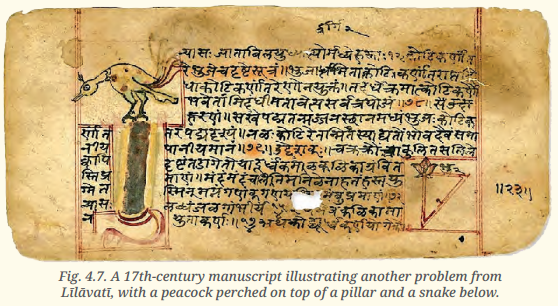
Question 1.
What animals you see in the picture?
(a) Snake
(b) Peacock
(c) Both (a) and (b)
(d) None of above
Answer:
(c) Both (a) and (b)
Question 2.
This manuscript is from which famous work :
(a) Lilavati
(b) Bijaganita
(c) Ganita
(d) Siddhantashiromani
Answer:
(a) Lilavati
II. Study the picture given below carefully and answer the following questions :
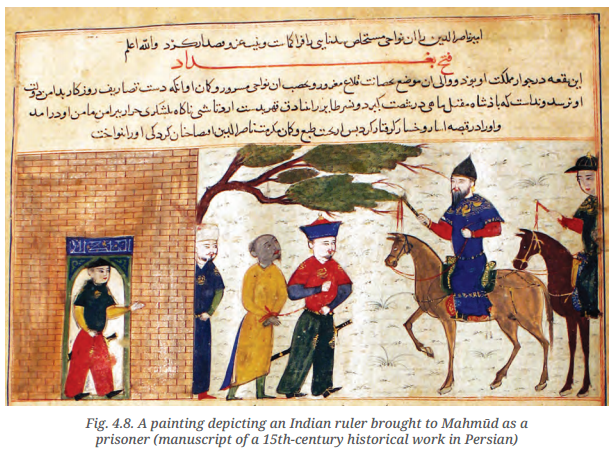
Question 1.
What can you depict in the painting?
(a) Soldiers
(b) Kings
(c) Indian ruler
(d) None of above
Answer:
(c) Indian ruler
Question 2.
In which language historical work is ’ done:
(a) Sanskrit
(b) Hindi
(c) English
(d) Persian
Answer:
(d) Persian
III. Study the picture given below carefully and answer the following questions :
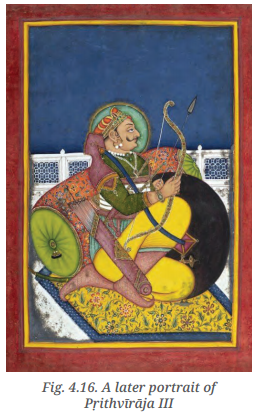
Question 1.
Name the King whose portrait you can see.
(a) Muhammad
(b) Prithviraj
(c) Prithviraj a III
(d) Bhoja
Answer:
(c) Prithviraja III
Question 2.
Prithviraja III waged many battles, with which states:
(a) Gujarat
(b) Malwa
(c) Both (a) and (b)
(d) Telangana
Answer:
(c) Both (a) and (b)
Class 7 Turning Tides: 11th and 12th Centuries Extra Questions for Practice
MCQs
Question 1.
Who was the first Turkish invader to invade India from the north western side?
a) Prithviraj III
b) Muhammad Ghori
c) Mahmud
d) Girja Ghazni
Question 2.
Which new dynsasty developed in eastern part of the country?
a) Cholas
b) Palas
c) Chaha Manas
d) Rashtrakudas
Question 3.
Who ruled in Tamil Nadu?
a) Cholas
b) Chalukyas
c) Rashtrakutas
d) None of these
Question 4.
What is the literal meaning of hiranya garbha?
a) Rashtrakutas
b) Danti gurba
c) Golden Womb
Question 5.
The person who received the land could collect taxes on :
a) betal leaves
b) woven clothes
c) vehicles
d) Golden Deer
Very Short Answer Type Questions:
Question 1.
Name the two major Turkic powers that launched invasions into North India during the 11th and 12th centuries.
Question 2.
What was the key tactical advantage that gave the Ghurid cavalry superiority over many Indian armies?
Question 3.
Who was the Chahamana ruler defeated by Muhammad Ghuri at the Second Battle of Tarain?
Question 4.
Which two major Buddhist universities were destroyed by Bakhtiyar Khilji in Eastern India?
Question 5.
In the visishtadvaita vedanta school, what is considered the ultimate path to the divine?
Short Answer Type Questions:
Question 1.
Briefly explain how the Katatiyas demonstrated strong local administration and infrastructure development in their kingdom.
Question 2.
State the significance of the Second Battle of Tarain (1192 CE) in the context of the political history of North India. 7
Question 3.
Describe the primary purpose and the style of the mathematical work Lilavati by Bha^karacharya.
Long Answer Type Questions:
Question 1.
Analyse the reasons why the 11th and 12th centuries are considered a period of transition in Indian history, highlighting both the elements of change and the elements of continuity.
Question 2.
Discuss the role of King Bhoja of the Paramara dynasty, detailing his contributions as both a ruler and a scholar, and mention his most famous work.
Class 7 SST Extra Questions
More from Class 7
- Banks and the Magic of Finance Class 7 Extra Questions and Answers SST Part 2 Chapter 8
- Infrastructure: Engine of India’s Development Class 7 Extra Questions and Answers SST Part 2 Chapter 7
- The State, the Government, and You Class 7 Extra Questions and Answers SST Part 2 Chapter 6
- India, a Home to Many Class 7 Extra Questions and Answers SST Part 2 Chapter 5
- Empires and Kingdoms: 6th to 10th Centuries Class 7 Extra Questions and Answers SST Part 2 Chapter 3
- India and Her Neighbours Class 7 Extra Questions and Answers SST Part 2 Chapter 2
More in Social Science
- Banks and the Magic of Finance Class 7 Extra Questions and Answers SST Part 2 Chapter 8
- Infrastructure: Engine of India’s Development Class 7 Extra Questions and Answers SST Part 2 Chapter 7
- The State, the Government, and You Class 7 Extra Questions and Answers SST Part 2 Chapter 6
- India, a Home to Many Class 7 Extra Questions and Answers SST Part 2 Chapter 5
- Empires and Kingdoms: 6th to 10th Centuries Class 7 Extra Questions and Answers SST Part 2 Chapter 3
- India and Her Neighbours Class 7 Extra Questions and Answers SST Part 2 Chapter 2