Empires and Kingdoms: 6th to 10th Centuries Class 7 Extra Questions and Answers SST Part 2 Chapter 3
Empires and Kingdoms: 6th to 10th Centuries Class 7 Extra Question Answer
Question 1.
Who revived the Chola dynasty in the 9th century?
Answer:
Vijayalaya revived the Chola dynasty in the 9th century with Tanjavur as the capital. Later, Aditya, I defeated the Pallavas and expanded the Chola kingdom further.
Question 2.
What system did kings use to manage the outer regions of their kingdoms?
Answer:
Kings ruled core areas directly and outer regions through samantas, who were vassals. Samantas managed local administration and armies, but they could sometimes rebel against their overlords.
Question 3.
What does the term Bhakti Movement refer to, and who led it in South India?
Answer:
The Bhakti Movement spread across India from the 6th century, emphasising devotion to God. In South India, the Alvars, who were Vishnu devotees, and Nayanars, who were Shiva devotees, led this movement.
Empires and Kingdoms: 6th to 10th Centuriess Class 7 Very Short Question Answer
Question 4.
What important mathematical concepts did Brahmagupta explain in his work?
Answer:
In the Brahmasphutasiddhanta, Brahmagupta explained operations with zero, negative numbers, and fractions. He also laid the foundations of algebra by developing new methods to solve equations.
Question 5.
Who conquered Sindh in the early 8th century and who defeated him later?
Answer:
Muhammad bin Qasim conquered Sindh in the early 8th century and defeated King Dahar, However, Nagabhata I of the Gurjara-Pratiharas later defeated Arab forces successfully.
Question 6.
What is special about the Kailashanatha temple at Ellora?
Answer:
The Kailashanatha temple at Ellora was built by Krishna I of the Rashtrakutas. It is the largest rock-cut temple in India and represents magnificent cultural achievement.
Extra Questions of Empires and Kingdoms: 6th to 10th Centuries Class 7
Question 7.
Who was Amoghavarsha I, and what was his other name?
Answer:
Amoghavarsha I was also called ‘Nripatunga’, meaning ‘peak of kings’. He ruled for 64 years in the 9th century, ensuring peace and prosperity in the kingdom.
Question 8.
What is the meaning of Kalhana’s work Rajatarangini?
Answer:
Rajatarangini means ‘River of Kings’. It was written by scholar-poet Kalhana in the 12th century and narrates the history of Kashmir’s dynasties from the beginning.
Question 9.
What did Kalhana believe about how historians should write history?
Answer:
Kalhana believed that historians should remain “free from love or hatred” when relating facts. He used inscriptions, temple records, and earlier works to write an accurate history.
Question 10.
How did Kashmir contribute to Buddhist scholarship in other regions?
Answer:
Kashmir acted as a bridge for Buddhist scholarship between India, Tibet, and Central Asia. It was a major centre of Sanskrit learning, philosophy, and the arts.
Question 11.
In which year did Harshavardhana become king, and where did he establish his rule?
Answer:
Harshavardhana became king in 606 CE at Kannauj, which was also known by its ancient name Kanyakubja. He belonged to the Pu§hyabhuti dynasty.
Question 12.
What does the title Maharajadhiraja’ mean?
Answer:
The title ‘Maharajadhiraja’ means ‘Great King of Kings’. This title was given to Harshavardhana after he expanded his empire over large parts of northern and eastern India.
Question 13.
Name the plays written by Harsha and the scholar he patronised who wrote his biography.
Answer:
Harsha was a poet and dramatist who wrote three plays in Sanskrit. He patronised the scholar Banabhatta, who wrote Harshacharita, which was Harsha’s biography.
Question 14.
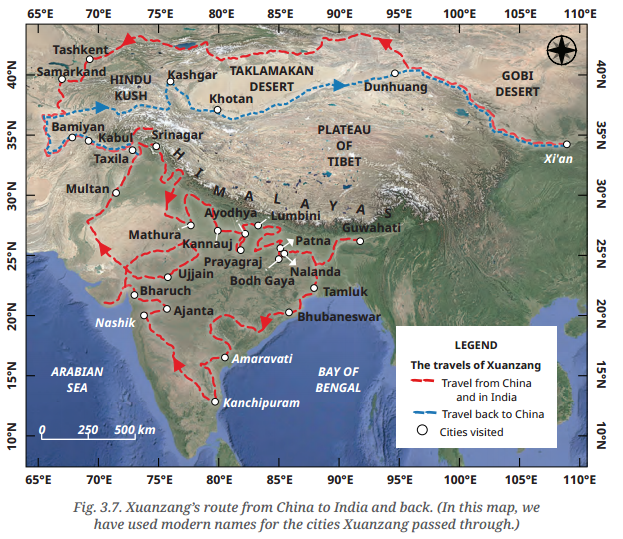
Why did Xuanzang visit India between 630-644 CE?
Answer:
Xuanzang was a Chinese pilgrim who came to India to visit Buddhist sites and learn from Indian teachers. He brought back over 600 Buddhist manuscripts to China.
Question 15
Which three dynasties fought for control of Kannauj during the 8th and 9th centuries?
Answer:
The Palas from the east, the Gurjara- Pratlharas from the west, and the Rashtrakutas from the Deccan fought for control of Kannauj during the 8th and 9th centuries.
Question 16
Who founded the Chalukya dynasty and when?
Answer:
The Chalukya dynasty was founded by Pulakeshin I in the mid-6th century CE. His grandson Pulakeshin II greatly expanded the Chalukya kingdom across the Deccan region.
Question 17
What major achievement did Pulakeshin II accomplish against Harsha?
Answer:
Pulakeshin II successfully checked Harsha’s southward expansion. In the early 7th century, both Harshavardhana in the north and Pulakeshin II in the south were major powers.
Question 18
What did Xuanzang say about the people of Kanchl?
Answer:
Xuanzang praised the people of Kanchl for being “deeply attached to honesty and truth” and valuing learning. He also mentioned numerous Buddhist monasteries and Hindu temples there.
Question 19.
What were the main exports from the Pallava kingdom through Mamallapuram?
Answer:
The Pallavas traded in spices, textiles, including silk, ivory, and luxury goods, through their seaport at Mamallapuram. Ancient Chinese, Persian, and Roman coins were found during excavations.
Question 20.
Who founded the Pala dynasty, and how did he come to power?
Answer:
Gopala founded the Pala dynasty in 750 CE. He was chosen by the people to restore stability in Bengal after a period of political turmoil.
Empires and Kingdoms: 6th to 10th Centuries Class 7 Short Question Answer
Question 1.
What was special about Kalhana’s RajataranginI?
Answer:
RajataranginI means ‘River of Kings’ and was written by scholar-poet Kalhana in the 12th century. It narrates the history of Kashmir’s dynasties from the beginning to his time. Kalhana used inscriptions, temple records, and earlier works to write accurate history. He believed historians should remain unbiased when relating facts.
Question 2.
Describe Xuanzang’s visit to India during Harsha’s reign.
Answer:
Xuanzang was a Chinese pilgrim who travelled in India between 630-644 CE. He came to visit Buddhist sites and learn from Indian teachers. He brought back over 600 Buddhist manuscripts to China. Harsha welcomed him and held a grand assembly at Kannauj in his honour. He left detailed accounts about India.
Question 3.
What were Brahmagupta’s major contributions to mathematics?
Answer:
Brahmagupta was born in 598 CE and made important contributions to mathematics and astronomy. In the Brahmasphutasiddhanta, he explained operations with zero, negative numbers, and fractions. He laid the foundations of algebra by developing new methods to solve equations. His works were translated into Persian and Latin.
Question 4.
Who was Pulakeshin II and what were his major accomplishments? ,
Answer:
Pulakeshin II was the grandson of Pulakeshin I who greatly expanded the Chalukya kingdom. He successfully checked Harsha’s southward expansion. Xuanzang visited the Chalukya kingdom and praised Pulakeshin II’s rule. A Sanskrit inscription by Ravikirti praises his victories, though it contains exaggerations.
Question 5.
Who was Harshavardhana and when did he become king?
Answer:
Harshavardhana became king in 606 CE at Kannauj. He belonged to the Pushyabhuti dynasty. The earlier capital was Sthaneshvara. He expanded his empire over large parts of northern and eastern India.
He was called ‘Maharajadhiraja’, meaning ‘Great King of Kings’.
Question 6.
Describe the trade and economy during the Pallava period.
Answer:
Kanchipuram was an important cultural centre and economic hub. Trade included spices, textiles like silk, ivory, and luxury goods. The seaport at Mamallapuram connected them with Southeast Asia. Ancient Chinese, Persian, and Roman coins were found during excavations, showing extensive international trade connections.
Question 7.
What were the main achievements of Vikramashila University?
Answer:
Vikramashila University had six colleges, monasteries, temples, lecture halls, and a vast library. Nearly 3,000 scholars studied subjects like grammar, logic, and philosophy. Each college had a dvarapandita who tested students before admission. It had strong ties with Tibet and helped shape Tibetan Buddhism.
Question 8.
How did the Hunas affect India, and what happened to them?
Answer:
The Hunas were nomadic warriors from Central Asia. They weakened the Gupta Empire but failed to establish lasting control. In the early 6th century, they invaded the Ganga plains but were defeated by the Aulikara kings. After defeat, the Hunas were assimilated into Indian society.
Question 9.
What was the Tripartite Struggle, and which dynasties were involved?
Answer:
After Harsha’s death in 647 CE, north India saw political turmoil. Three powerful dynasties fought for control of Kannauj during the 8th and 9th centuries. These were the Palas from the east, Gurjara-Pratlharas from the west, and Rashtrakutas from the Deccan. Kannauj was important for its strategic location.
Empires and Kingdoms: 6th to 10th Centuries Class 7 Long Question Answer
Question 1.
Explain the cultural importance of Kashmir during the 6th to 10th centuries.
Answer:
Kashmir remained well connected to India’s political and cultural life despite its geography. It was a major centre of Sanskrit learning, philosophy, and the arts. Kashmir Shaivism developed here, with scholars like Abhinavagupta whose works influenced philosophy, aesthetics, poetry, and arts across India. Kashmir acted as a bridge for Buddhist scholarship between India, Tibet, and Central Asia. Kashmiri artisans, sculptors, and manuscript painters were highly valued across regions, making Kashmir an important intellectual and artistic hub during this period.
Question 2.
What were the achievements of Amoghavarsha I of the Rashtrakuta dynasty?
Answer:
Amoghavarsha I was also called ‘Nripatunga’, meaning ‘peak of kings’. He ruled for 64 years in the 9th century, ensuring peace and prosperity throughout his reign. He was strongly drawn to Jainism but also patronised Hindu temples, showing religious tolerance. He was a fine poet in both Sanskrit and Kannada languages. The Arab historian Al- Masudi praised him for respecting Muslims and building mosques in his kingdom, demonstrating his acceptance of all religions and cultures within his empire.
Question 3.
Explain the cultural and religious contributions of Harshavardhana during his rule.
Answer:
Harshavardhana was a poet and dramatist who wrote three plays in Sanskrit. He patronised scholars like Banabhatta, who wrote Kadambari, one of the world’s first novels, and Harshacharita, which was Harsha’s biography. He was devoted to Shiva and Buddhism but respected all beliefs. Every five years, he held an assembly at Prayaga where he gave away wealth to Buddhists, Brahmins, and the poor, showing his generosity and religious tolerance towards different communities.
Question 4.
How did the Bhakti Movement transform religious and social life in India during this period?
Answer:
From the 6th century, the Bhakti Movement spread across India, transforming religious practices. The Alvars, who were Vishnu devotees, and the Nayanars, who were Shiva devotees, led the movement in the South. The movement emphasised personal devotion to God over elaborate rituals. Most importantly, Bhakti cut across social divisions, including caste and gender barriers. This made religion more accessible to common people and challenged rigid social hierarchies. Religion increasingly centred on temples, mathas, pilgrimage, and bhakti devotion during this transformative period.
Question 5.
Describe the role of Dharmapala in promoting Buddhism and education in eastern India.
Answer:
Dharmapala was the successor of Gopala and expanded the Pala empire over much of eastern and northern India. He was a great patron of Mahayana Buddhism. He founded Vikramashila monastery in Bihar in the late 8th century, which became a major centre of learning. He also patronised Nalanda university and founded Somapura monastery in present-day Bangladesh. Under his patronage, these institutions flourished and attracted thousands of scholars, helping spread Buddhist learning and maintaining strong ties with Tibet.
Empires and Kingdoms: 6th to 10th Centuries Class 7 Source/Case Based Questions
1. Read the following extract and answer the questions that follow:
Harsha (as he is also known) was a fine poet and dramatist; he is assumed to be the author of three plays composed in classical Sanskrit, which weave love stories with courtly life, or themes of sacrifice and other high ethical values. While these are ‘stories’, historians use such literature to extract interesting details about the culture and society of those times — from systems of governance to social diversity, technologies, foods, and clothing. Harsha also patronised scholars like Banabhatta (also known as Bana), who wrote Kadambarl, a beautiful literary work and one of the world’s first novels. Bana also composed a biography of Harsha titled Harshacharita. Inscriptions depict Harsha as a devotee of Shiva; according to other sources, he was also deeply attached to Buddhism, while showing respect for all schools of thought and belief.
Question (i).
Where did Harshavardhana establish his rule?
(a) Kamarupa
(b) Kannauj
(c) Eastern India
(d) None of above
Answer:
(b) Kannauj
Question (ii).
What does reverse side of coin depicts?
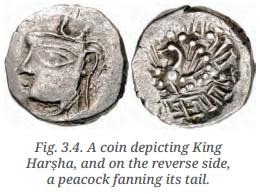
(a) King Harsha
(b) Animal face
(c) Peacock fanning its tail
(d) Mermaid
Answer:
(c) Peacock fanning its tail
Question (iii).
Name the Harsha's biography.
(a) Charita
(b) Harshacharita
(c) Ramcharita
(d) Bama
Answer:
(b) Harshacharita
Question (iv).
In which year Haishavardhana became King? What was the name of his dynasty?
Answer: Harshavardhana became king in 606 CE at Kannauj. He belonged to the Pushyabhuti dynasty.
2. Read the following extract and answer the questions that follow:
Far to the north, in the mid-8th century, a new power was stirring in the Himalayan kingdom of Kashmlra — present-day Kashmir. Apart from inscriptions and coins, we learn about its successive rulers from Kalhana, who authored RajataranginI — literally ‘the River of Kings’ (see the Box below). Among the many kings and a few queens whose rule Kalhana describes, Lalitaditya Muktapida of the Karkota dynasty is seen as a firm ruler. After him, however, Kashmir’s political scene experienced many internal ^conflicts and shifts of power, including some rulers seizing the throne by force. In the late 10th century, for instance, Queen Didda consolidated her power through strategic alliances but also, according to Kalhana, by ruthlessly eliminating rivals, including her own grandsons. She founded a few towns, built several temples, and restored many more.
Question (i).
What was the ancient name of Kashmir?
(a) Mira
(b) Ashmira
(c) Kashmlra
(d) Karkota
Answer:
(c) Kashmlra
Question (ii).
After him, Kashmir's experienced many internal conflicts - who does 'him' here refers to?
(a) Harshavardhan
(b) Kalhana
(c) Lalitaditya Muktapida
(d) Both (a) and (b)
Answer:
(c) Lalitaditya Muktapida
Question (iii).
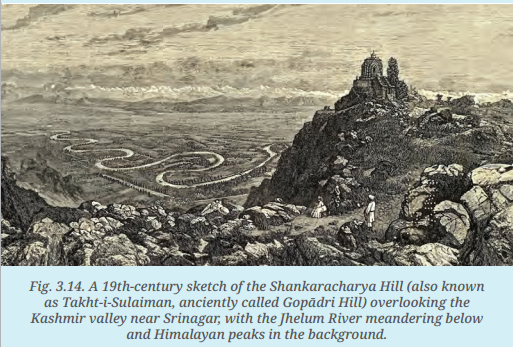
Name the hill you can see in picture.
(a) Takht-i-Sulaiman
(b) Shankaracharya Hill
(c) Both (a) and (b)
(d) None of above
Answer:
(c) Both (a) and (b)
Question (iv).
In the late 10th century, who and how through power founded few towns and built several temples?
Answer:
Queen Didda consolidated her power through strategic alliances but also, according to Kalhana, by ruthlessly eliminating rivals, including her own grandsons. She founded a few towns, built several temples, and restored many more.
3. Read the following extract and answer the questions that follow:
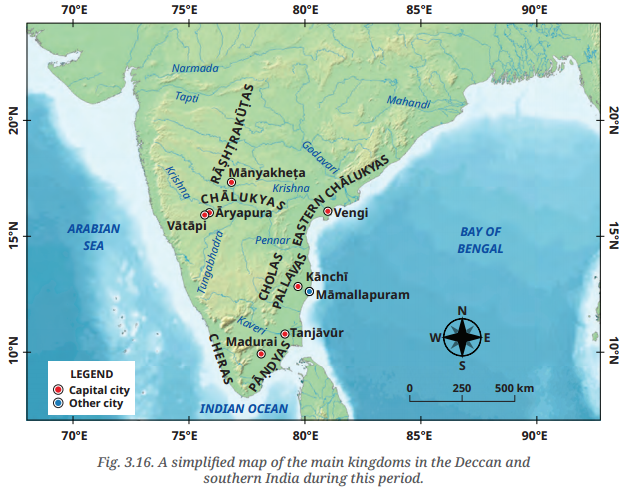
In the Grade 7 Part 1 textbook, we saw the emergence of the Pallavas. With its capital at Kanchl (or Kanchipura, present-day Kanchipuram in Tamil Nadu, Fig. 3.16), the dynasty reached its peak in the 7th century under Mahendravarman I and his son Narasimhavarman I. The latter was also known as ‘Mamalla’, which means ‘wrestler’ or ‘warrior’; indeed, it was he who defeated Pulakeshin II and went on to capture Badami. However, he retreated, keeping the Tungabhadra River as an unwritten boundary between the two powers. He also sent a naval expedition to Sri Lanka to help a Sinhalese prince recover his lost throne.
Kanchipuram was not only an important cultural centre but also an economic hub, with trade in goods such as spices, textiles (including silk), ivory and other luxury goods. The Pallavas developed trade relations not only with Sri Lanka but also with much of Southeast Asia via several seaports, in particular Mamallapuram (also known as Mahabalipuram, see Fig. 3.16), where ancient Chinese, Persian, and Roman coins were found during excavations.
Question (i).
By which other name Narasimhavarman 1 was known?
(a) Varman
(b) Narasimha
(c) Mamalla
(d) Mahendra
Answer:
(c) Mamalla
Question (ii).
After defeating Pulakeshin II, which country Narasimhavarman I captured?
(a) Kanchi
(b) Badami
(c) Sri Lanka
(d) Mahabalipuram
Answer:
(b) Badami
Question (iii).
What were the main exports from Pallava Kingdom through Mamallapuram?
(a) Textiles
(b) Spices
(c) Luxury goods
(d) All of above
Answer:
(d) All of above
Question (iv).
Who was Narasimhavarman I, and what does his title mean?
Answer:
Narasimhavarman I was a Pallava king also called ‘Mamalla’, meaning ‘wrestler’ or ‘warrior’. He defeated Pulakeshin II and captured Badami, expanding Pallava power significantly.
Empires and Kingdoms: 6th to 10th Centuries Class 7 Picture Based Questions
I. Study the picture given below carefully and answer the following questions :
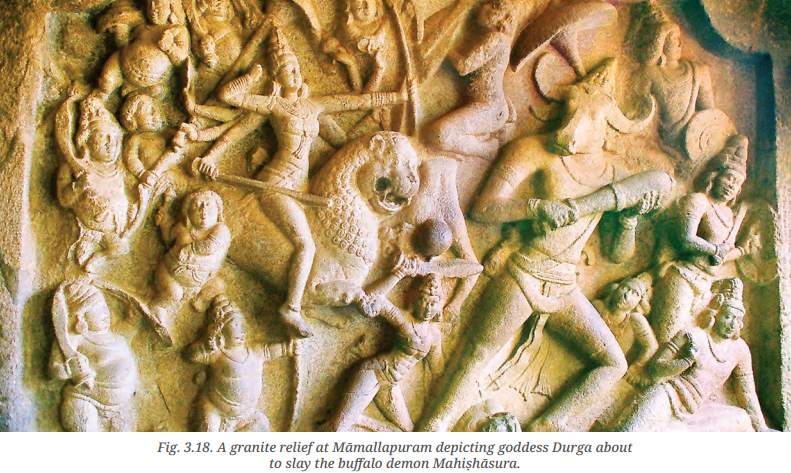
Question 1.
What all weapons Can you identify in picture?
(a) Trishula
(b) Chakra
(c) Khadga
(d) All of above
Answer:
(d) All of above
Question 2.
Her divine vehicle (Vahana) indicates which animal?
(a) Lion
(b) Tiger (sometimes)
(c) Both (a) and (b)
(d) Elephant
Answer:
(c) Both (a) and (b)
Question 3.
By seeing her demon's attendants how one feel.
(a) Fearful
(b) Calon
(c) Lost
(d) Happy
Answer:
(a) Fearful
Question 4.
What does the demon’s slanted posture and general attitude indicate?
Answer:
The slanted posture and general attitude of the demon Mahishasura represent a critical moment of transition between arrogance and inevitable defeat. The demon's attitude reflects the realization that his immense physical strength and the boons that protected him from men and gods are insufficient against the divine feminine power (Shakti).
Empires and Kingdoms: 6th to 10th Centuries Class 7 Map Based Questions
Question 1.
After Gupta era is gone about 600 CE to about 1200 CE some more regional powers emerged. Locate them on map of India.
Answer:
(a) Kanyakubja
(b) Sthaneshvara
(c) Manyakheta
(d) Pushyabhutis
Question 2.
Locate main kingdoms in the Deccan and southern India on the map of India.
Answer:
(a) Cheras
(b) Pandyas
(c) Cholas
(d) Pallavas
Class 7 Empires and Kingdoms: 6th to 10th Centuries Extra Questions for Practice
MCQs
Question 1.
The famous rock-cut relief‘Descent of the Ganges’ or ‘Arjuna’s Penance’ is found at:
a) Ellora
b) Ajanta
c) Mamallapuram
d) Elephanta
Question 2.
Who composed the ‘Kadambari’?
a) Harsha
b) Banabhatta
e) Kalhana
d) Ravikirti
Question 3.
The ‘Eastern Chalukyas’ ruled from:
a) Badami
b) Kalyani
c) Vengi
d) Manyakheta
Question 4.
Which ruler held a great assembly at Prayaga every five years to give away wealth?
a) Pulakeshin II
b) Harshavardhana
c) Dharmapala
d) Raja Raja Chola
Very Short Answer Type Questions:
Question 1.
Name the dynasty that ruled from Kanchipuram and built the temples at Mamallapuram.
Question 2.
What was the main purpose of the village assemblies (sabha and ur) during the Chola period?
Short Answer Type Questions:
Question 1.
Describe the main features of the Tripartite Struggle and explain why Kannauj was important for the competing dynasties.
Question 2.
How did the Pallavas and Rashtrakutas contribute to the development of temple architecture in early medieval India?
Long Answer Type Questions:
Question 1.
Discuss the significance of administrative systems during this period, with special reference to land grants, village assemblies and the
contributions of different dynasties to governance and economic growth.
Question 2.
Explain the cultural importance of Kashmir during the 6th to 10th centuries.
Class 7 SST Extra Questions
More from Class 7
- Banks and the Magic of Finance Class 7 Extra Questions and Answers SST Part 2 Chapter 8
- Infrastructure: Engine of India’s Development Class 7 Extra Questions and Answers SST Part 2 Chapter 7
- The State, the Government, and You Class 7 Extra Questions and Answers SST Part 2 Chapter 6
- India, a Home to Many Class 7 Extra Questions and Answers SST Part 2 Chapter 5
- Turning Tides: 11th and 12th Centuries Class 7 Extra Questions and Answers SST Part 2 Chapter 4
- India and Her Neighbours Class 7 Extra Questions and Answers SST Part 2 Chapter 2
More in Social Science
- Banks and the Magic of Finance Class 7 Extra Questions and Answers SST Part 2 Chapter 8
- Infrastructure: Engine of India’s Development Class 7 Extra Questions and Answers SST Part 2 Chapter 7
- The State, the Government, and You Class 7 Extra Questions and Answers SST Part 2 Chapter 6
- India, a Home to Many Class 7 Extra Questions and Answers SST Part 2 Chapter 5
- Turning Tides: 11th and 12th Centuries Class 7 Extra Questions and Answers SST Part 2 Chapter 4
- India and Her Neighbours Class 7 Extra Questions and Answers SST Part 2 Chapter 2