Infrastructure: Engine of India’s Development Class 7 Extra Questions and Answers SST Part 2 Chapter 7
Infrastructure: Engine of India’s Development Class 7 Extra Question Answer
Question 1.
How many people does Indian Railways employ?
Answer:
Indian Railways is the largest employer with about 1.21 million employees in 2024. These include engineers, ticket collectors, and service staff, creating many indirect jobs too.
Question 2.
What are the main benefits of metro train systems in Indian cities?
Answer:
Metro trains offer fast and reliable travel, reduce road traffic, and lower pollution by using cleaner fuels like electricity. Some metros also use solar power for operation.
Question 3.
Why is air transport particularly helpful during disasters?
Answer:
Air transport is particularly helpful in delivering aid during disasters like floods and earthquakes. It can reach difficult terrains like high mountains, deserts, and dense forests quickly.
Infrastructure: Engine of India’s Development Class 7 Very Short Question Answer
Question 4.
How many airports does India have in 2025?
Answer:
In 2025, India has 159 airports. India has the third-highest domestic air traffic in the world, handling around 376 million passengers in 2024 to 2025.
Question 5.
Why is shipping considered cheaper for heavy goods?
Answer:
Shipping is a cheaper mode of transport for heavy goods like coal, cars, and cement over long distances. India’s approximately 11,100-kilometre coastline supports trade through shipping.
Question 6.
What is physical infrastructure?
Answer:
Physical infrastructure is a vast network of tangible structures built to keep our cities and villages functioning. It includes transportation systems, utilities, communication networks, and energy infrastructure.
Extra Questions of Infrastructure: Engine of India’s Development Class 7
Question 7.
What are the main components of transportation systems in physical infrastructure?
Answer:
The main components of transportation systems include roads, bridges, railways, metro trains, airports, and ports. These structures help connect people and places across the country.
Question 8.
Why is physical infrastructure called the backbone of the nation?
Answer:
Physical infrastructure is called the backbone of the nation because it makes life easier for people, businesses, and the government. It connects producers to markets and supports tourism and emergencies.
Question 9.
What is India’s ranking in the world for road network size?
Answer:
India has the second-largest road network in the world after the United States as of 2024. This extensive network connects cities, towns, and villages across the country.
Question 10.
What are local roads, and how do they help communities?
Answer:
Local roads are near your home and help children reach school, farmers carry crops to markets, and ambulances reach hospitals. They serve the everyday needs of local communities.
Question 11.
What happens when Rani sends a voice note from Madhya Pradesh to Tamil Nadu?
Answer:
The message travels through mobile towers powered by electricity, through fibre cables, gets transmitted to satellites in space, travels through servers, and finally appears on her cousin’s phone.
Question 12.
How does e-governance help citizens?
Answer:
E-governance allows citizens to apply for documents, file complaints, or get information easily using communication technologies. An example is the DigiLocker app for storing and accessing documents.
Question 13.
What was J. C. Bose’s contribution to communication in India?
Answer:
J. C. Bose pioneered wireless communication in India. In 1895, he demonstrated wireless signals passing through walls and invented key wireless devices, influencing later radio communication developments.
Question 14.
What are examples of social infrastructure in communities?
Answer:
Social infrastructure includes schools, colleges, training centres, hospitals, health centres, police stations, fire stations, courts, parks, libraries, and community centres that support community wellbeing and development.
Question 15.
What did the Arthashastra emphasise about infrastructure?
Answer:
The Arthashastra emphasised planned infrastructure under state supervision. Roads had fixed widths based on their purpose and traffic, and damage to public works attracted strict punishments and fines.
Infrastructure: Engine of India’s Development Class 7 Short Question Answer
Question 1.
What is infrastructure, and why is it considered the engine of India’s development?
Answer:
Infrastructure refers to the fundamental facilities and systems serving a country, city, or area, including transportation, communication, sewage, water, and electric systems. It is considered the engine of India’s development because it supports economic growth, enhances productivity, and improves the quality of life for citizens by providing essential services and connectivity.
Question 2.
How does transportation infrastructure contribute to economic development in India?
Answer:
Transportation infrastructure, such as roads, railways, and airports, facilitates the movement of goods and people. It reduces travel time and costs, thereby enhancing trade, boosting tourism, and creating job opportunities. Efficient transportation networks are crucial for linking rural areas with urban markets, thus promoting overall economic development.
Question 3.
What role does communication infrastructure play in modernising India?
Answer:
Communication infrastructure, including telecommunication networks and the internet, plays a vital role in modernising India by enabling efficient information exchange, fostering innovation, and improving access to education and services. It connects people and businesses, supports e-governance, and enhances digital literacy, which is essential for socio-economic growth.
Question 4.
Why is investment in infrastructure important for sustainable development?
Answer:
Investment in infrastructure is important for sustainable development as it ensures that essential services are provided in an environmentally responsible manner. Sustainable infrastructure helps reduce carbon footprints, promotes renewable energy, and enhances resilience to climate change. It supports long-term economic growth without compromising the needs of future enerations.
Question 5.
What challenges does India face in developing its infrastructure?
Answer:
India faces several challenges in developing its infrastructure, including funding limitations, bureaucratic hurdles, land acquisition issues, and regulatory complexities. Additionally, rapid urbanisation and population growth put pressure on existing infrastructure, requiring innovative solutions and efficient management to meet the increasing demand for services.
Question 6.
Explain how the Dhola Sadiya Bridge has improved the lives of people in Assam and Arunachal Pradesh.
Answer:
The Dhola Sadiya Bridge, also called Bhupen Hazarika Setu, connects Assam and Arunachal Pradesh across the Lohit River. Before its construction, people relied on ferries that did not operate during floods. The bridge provides year-round travel, cutting journey time by four hours. Farmers can now transport vegetables and fruits to piarkets before they spoil, whilst people can access hospitals and medicines faster even during floods.
Question 7.
Describe the significance of living root bridges in Meghalaya and how they are constructed.
Answer:
Living root bridges, called jingkieng jri in Khasi language, are crafted by the Khasi and Jaintia tribes of Meghalaya using roots of Ficus elastica trees. Indigenous people guide roots across streams with bamboo and palm trunks. Over decades or centuries, roots grow stronger and twist into natural bridges standing 15-30 metres high. These living structures reflect local knowledge about nature, have cultural meaning, and connect generations.
Question 8.
Why were railways introduced in India by the British, and how did they impact Indian society?
Answer:
The British introduced railways in India in 1853 primarily to transport raw materials like cotton and tea to ports for export to Britain. They also wanted to move British goods across India, exploit resources, and enable quicker troop movement. As the railway network expanded, trade grew, major markets developed, and new settlements emerged near stations. Railways eventually became the lifeline for moving people and goods across India.
Question 9.
How has modern communication infrastructure benefited Indian society across different sectors?
Answer:
Modern communication infrastructure has transformed Indian society significantly. In education, students access online classes, digital libraries, and educational videos even in remote areas. Quick mobile alerts help during natural disasters for emergency response. Businesses sell products globally through e-commerce platforms. E-governance enables citizens to apply for documents, file complaints, and get information easily through services like DigiLocker, promoting ease of living for communities nationwide.
Question 10.
What is the collective responsibility of citizens and government towards maintaining public infrastructure in India?
Answer:
Protecting public infrastructure is a shared responsibility of government and citizens. Littering, defacing buildings, and damaging monuments reduce ease of living. Panchayats and municipalities must improve waste management, sanitation, traffic, and water supply. Infrastructure should be safe, inclusive, and environmentally sustainable using clean energy and eco-friendly materials. Citizens must use public facilities responsibly and report damage like potholes or broken lights to authorities.
Question 11.
What is the significance of infrastructure in India’s development?
Answer:
Infrastructure is crucial for India’s development as it supports economic growth, facilitates trade, and improves the quality of life. It includes transportation, communication, energy, and water supply systems, which are essential for enabling various sectors of the economy to function efficiently
Question 12.
How does transportation infrastructure contribute to economic growth?
Answer:
Transportation infrastructure, such as roads, railways, and airports, enhances connectivity, reduces travel time and costs, and facilitates the movement of goods and people. This improved accessibility stimulates trade, attracts investments, and ultimately boosts economic activities.
Question 13.
What role does energy infrastructure play in India’s progress?
Answer:
Energy infrastructure, including power generation and distribution systems, is vital for sustaining industries, supporting technological advancements, and providing electricity to households. Reliable energy supply is essential for economic stability and growth, as it powers various sectors like manufacturing and services.
Question 14.
Why is water supply considered a critical component of infrastructure?
Answer:
Water supply infrastructure is essential for public health, agriculture, and It ensures access to clean drinking water, supports irrigation for food production, and is necessary for many industrial processes. A reliable water supply system contributes to overall societal well-being and economic productivity.
Question 15.
How can communication infrastructure impact social development?
Answer:
Communication infrastructure, including telecommunication and internet services, fosters social development by enabling access to information, education, and healthcare. It allows for better interaction among communities, promotes digital literacy, and supports e-governance initiatives, enhancing the quality of life and civic engagement.
Infrastructure: Engine of India’s Development Class 7 Long Question Answer
Question 1.
How has modern communication infrastructure benefited different sectors of Indian society?
Answer:
Modern communication infrastructure has benefited many sectors. In education, students can access online classes, digital libraries, and educational videos, even in remote areas. During emergencies, quick mobile alerts help during natural disasters. In business, small and large businesses sell products across the world through e-commerce platforms on the internet. E-governance helps citizens apply for documents, file complaints, or get information easily using communication technologies. This promotes ease of living for communities across India.
Question 2.
How have Indian Railways evolved, and what is their current importance to the nation?
Answer:
Indian Railways have evolved significantly since their introduction by the British in eighteen fifty-three. Today, it is the fourth- largest railway system in the wot Id, carrying over twenty million passengers every day. It offers one of the cheapest train services globally. Cargo trains carry coal, grains, textiles, and electronics using seventy- five to ninety per cent less energy than road transport. India is aiming to have one hundred per cent trains running on electricity by twenty twenty-five, which is better for the environment.
Question 3.
Explain the different types of roads in India and their specific purposes.
Answer:
India has three main types of roads. Local roads are near homes and help children reach school, farmers carry crops to markets, and ambulances reach hospitals. State highways connect towns and districts within a state and are built and maintained by the state through public works departments. National highways and expressways are super-fast roads that join cities across states, built and maintained by the central government. They connect with railway stations, airports, and ports. India has the second-largest road network in the world.
Question 4.
What is the collective responsibility of citizens and government towards infrastructure, and why is it important?
Answer:
Protecting public infrastructure is a shared responsibility of government and citizens. Littering, defacing buildings, and damaging monuments reduce ease of living. Panchayats and municipalities must improve waste management, sanitation, traffic, and water supply. Infrastructure should be safe, inclusive, and environmentally sustainable. Use of clean energy and eco-friendly materials reduces pollution. Infrastructure design should consider children, the elderly, and persons with disabilities. Citizens must use public facilities responsibly and report damage like potholes or broken lights to maintain quality infrastructure.
Question 5.
Describe India’s shipping and ports infrastructure and explain why it is important for trade.
Answer:
India has approximately even thousand one hundred kilometres of coastline connected to regions like West Asia, Africa, and Europe. This supports trade through shipping. Shipping is a cheaper mode of transport for heavy goods like coal, cars, and cement over long distances. India has twelve major ports and two hundred seventeen minor ports where ships dock, and goods are loaded and unloaded. The volume of cargo handled has increased by fifty percent in the past decade, showing growing trade activity.
Question 6.
Trace the development of Indian Railways from 1853 to the present day. Explain its importance to India’s economy and society.
Answer:
The British introduced railways in India in 1853 to transport raw materials to ports and move troops. As the railway network expanded, trade grew, major markets developed, and new settlements emerged near stations. Today, Indian Railways is the fourth-largest railway system in the world, carrying over 20 million passengers every day. It is one of the cheapest train services in the world. Cargo trains carry coal, grains, textiles, and electronics using 75-90% less energy than road transport. Indian Railways is the largest employer with about 1.21 million employees and creates many indirect jobs in catering, vending, and taxi services. India is aiming to have 100% trains running on electricity by 2025, which is better for the environment.
Question 7.
What is collective responsibility towards infrastructure? Explain why it is important and how both government and citizens can contribute.
Answer:
Collective responsibility towards infrastructure means that both the government and citizens share the duty of protecting and maintaining public facilities. India has developed major infrastructure, but misuse and damage remain challenges. Littering, defacing buildings, and damaging monuments reduce the ease of living. Panchayats and municipalities must improve waste management, sanitation, traffic, and water supply. Infrastructure should be safe, inclusive, and environmentally sustainable by using clean energy and eco-friendly materials to reduce pollution. Infrastructure design should consider children, the elderly, and persons with disabilities. Citizens must use public facilities responsibly and report damage like potholes or broken lights. When everyone works together, infrastructure can serve the community better and last longer for future generations.
Infrastructure: Engine of India’s Development Class 7 Source/Case Based Questions
1. Read the following extract and answer the questions that follow:
Highways cannot be built everywhere especially in difficult terrains like , dense forests, wide river beds, and steep mountains. In such cases, bridges and tunnels enable ease of access. For instance, the Dhola Sadiya Bridge (or the Bhupen Hazarika Setu) connects Assam and Arunachal Pradesh across the Lohit River, a tributary of the Brahmaputra. At 9.15 km, it is the second longest bridge in India. Before it was built, people had to rely on ferries for travel, which did not work during floods. Now, the bridge provides year-round travel and has cut travel time by four hours. Farmers can take their vegetables and fruits to the market before they spoil, and people can access hospitals or medicines faster, even during floods.
Another infrastructure marvel closer to nature is the Meghalaya’s living root bridges which are crafted by the indigeneous Khasi and Jaintia tribes using the roots of the Ficus elastica tree or the Indian rubber tree. They guide the roots across streams with bamboo and palm trunks, and over many years the roots grow stronger, twisting into natural bridges. Some take decades or even centuries to mature and can last for hundreds of years, standing 15-30 m high. These bridges are not just pathways but living and growing structures which have been nurtured over generations. They are a reflection of the knowledge that the local people have about Nature; these bridges have a cultural meaning too, connecting one generation to another.
Question (i).
Where highways cannot be made what are made?
(a) Bridges
(b) Tunnels
(c) Both (a) and (b)
(d) None of above
Answer:
(c) Both (a) and (b)
Question (ii).
What is the other option of making natural bridges?
(a) Bamboo
(b) Roots of trees
(c) Wood
(d) Steel
Answer:
(b) Roots of trees
Question (iii).
How can bridges useful and important?
Answer:
Bridges provides easy access, people can travel year-round in any weather and it cuts travel time also.
Question (iv).
What are the main components of transport in physical infrastructure?
(a) Bridges
(b) Railways
(c) Metro trains
(d) All of above
Answer:
(d) All of above
2. Read the following extract and answer the questions that follow:
While India has developed major physical infrastructure in terms of airports, highways and so on, there still exist some challenges which need to be solved. We see roads being littered, stains on buildings, or writings on monuments. Such damage to public infrastructure reduces ease of living for people and becomes a burden for every citizen. Taking care of public infrastructure is a collective responsibility.
We also need to improve Panchayat and municipal administrative services for waste management, sewer systems, traffic management, provision of clean and safe drinking water, pedestrian- friendly footpaths. In addition, we need safe and sustainable infrastructure that uses cleaner energy and environment-friendly materials to minimise pollution and harm to bio-diversity — for instance, using solar panels for generating electricity for the buildings can reduce emissions. The design of the infrastructure should consider the needs of children, the elderly and disabled persons.
Question (i).
How can municipal administrative services can be improved?
(a) By managing traffic
(b) By providing clean drinking water
(c) Both (a) and (b)
(d) None of above
Answer:
(c) Both (a) and (b)
Question (ii).
Which challenges need to be solved to improve physical infrastructure?
(a) Improving poor waste management
(b) Stop writing on monuments
(c) Roads to be improved
(d) All of above
Answer:
(d) All of above
Question (iii).
The design of the infrastructure should consider:
(a) Needs of children
(b) Disabled persons
(c) Elderly persons
(d) All of above
Answer:
(d) All of above
Question (iv).
What is the collective responsibility of citizens? How?
Answer:
Taking care of public infrastructure is a collective responsibility of citizens. Citizens must use public facilities responsibly and report if they found any one damaging the public property.
Infrastructure: Engine of India’s Development Class 7 Picture Based Questions
I. Study the picture given below carefully and answer the following questions :
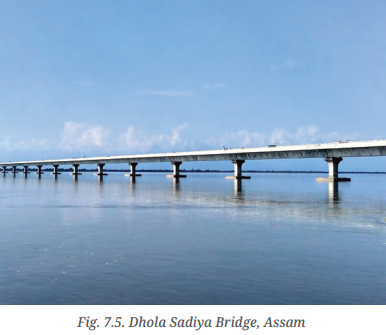
Question 1.
Which bridge can you see in picture?
(a) Howrah Bridge
(b) Dhola Sadiya Bridge
(c) Pamban Bridge
(d) Chenab Bridge
Answer:
(b) Dhola Sadiya Bridge
Question 2.
Across which river it is located?
(a) Pranhita
(b) Maner
(c) Lohit
(d) Godavari
Answer:
(c) Lohit
Question 3.
At which number this bridge is in India?
(a) 1st
(b) IInd
(c) IIIrd
(d) IVth
Answer:
(b) Ilnd
Question 4.
Before bridges were made, how people travelled? How bridges are important?
Answer:
Before bridges were made people had to rely on ferries for travel, which did not work during floods. Now, the bridge provides year- round travel and has cut travel time by four hours.
Infrastructure: Engine of India’s Development Class 7 Map Based Questions
Question 1.
Locate on map of India, names of major seaports of India and where they are situated.
(a) Kandla Port
(b) Kochi Port
(c) Portblair
(d) Haldia Port
(e) Morgugao Port
(f) Tuticorin Port
Answer:
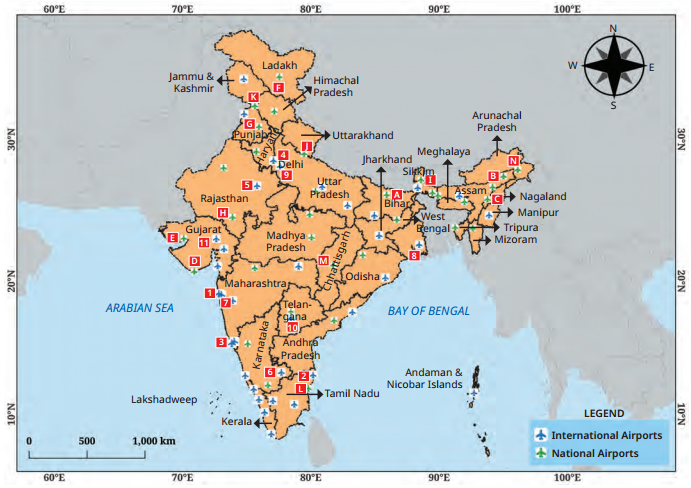
The seaports are situated at
(a) Gujarat
(b) Kerala
(c) Andaman & Nicobar Islands
(d) Odisha
(e) Goa
(f) Tamil Nadu
Class 7 Infrastructure: Engine of India’s Development Extra Questions for Practice
MCQs
Question 1.
Which of the following is an example of collective responsibility towards public infrastructure?
(a) Scribbling on public walls
(b) Ignoring damaged streetlights
(c) Properly disposing waste and reporting damage
(d) Leaving garbage on roads
Question 2.
Which energy source powers Cochin International Airport?
(a) Diesel
(b) Solar
(c) Wind
(d) Thermal
Question 3.
Which of the following is NOT a part of communication infrastructure?
(a) Fibre cables
(b) Telecom towers
(c) Satellites
(d) Dams
Question 4.
The first railway line in India was built in:
(a) 1853
(b) 1947
(c) 1920
(d) 1890
Question 5.
Which of the following is true about India’s shipping infrastructure?
(a) India has 50 major ports and 11 minor ports
(b) Shipping is expensive for transporting heavy goods over long distances
(c) India’s coastline connects it to Africa, West Asia, and Europe
(d) Only minor ports handle container cargo in India
Very Short Answer Type Questions
Question 1.
Give any one example of physical infrastructure.
Question 2.
How many major ports does India have? Name some.
Question 3.
What type of energy should be used for sustainable infrastructure?
Question 4.
Which component stores and processes digital information during communication?
Question 5.
Name one national and one international airports in India.
Short Answer Type Questions
Question 1.
How do well-developed road networks influence the efficiency and profitability of agricultural supply chains?
Question 2.
How did people travel across the Lohit River before the Dhola Sadiya Bridge was built?
Question 3.
Why do airports become critical components of disaster management systems, especially when other forms of transport fail or become inaccessible?
Long Answer Type Questions
Question 1.
How does the electrification of Indian Railways and its status as a top employer significantly impact India’s environmental sustainability and national economic prosperity?
Question 2.
How did Jagadish Chandra Bose’s decision not to patent his microwave innovations, in contrast to Guglielmo Marconi’s actions, affect his international recognition and legacy in the history of wireless technology?
Class 7 SST Extra Questions
More from Class 7
- Banks and the Magic of Finance Class 7 Extra Questions and Answers SST Part 2 Chapter 8
- The State, the Government, and You Class 7 Extra Questions and Answers SST Part 2 Chapter 6
- India, a Home to Many Class 7 Extra Questions and Answers SST Part 2 Chapter 5
- Turning Tides: 11th and 12th Centuries Class 7 Extra Questions and Answers SST Part 2 Chapter 4
- Empires and Kingdoms: 6th to 10th Centuries Class 7 Extra Questions and Answers SST Part 2 Chapter 3
- India and Her Neighbours Class 7 Extra Questions and Answers SST Part 2 Chapter 2
More in Social Science
- Banks and the Magic of Finance Class 7 Extra Questions and Answers SST Part 2 Chapter 8
- The State, the Government, and You Class 7 Extra Questions and Answers SST Part 2 Chapter 6
- India, a Home to Many Class 7 Extra Questions and Answers SST Part 2 Chapter 5
- Turning Tides: 11th and 12th Centuries Class 7 Extra Questions and Answers SST Part 2 Chapter 4
- Empires and Kingdoms: 6th to 10th Centuries Class 7 Extra Questions and Answers SST Part 2 Chapter 3
- India and Her Neighbours Class 7 Extra Questions and Answers SST Part 2 Chapter 2