Climates of India Class 7 Question Answer Social Science SST Chapter 3
Class 7 SST Chapter 3 Climates of India Question Answer
Climates of India Class 7 Questions and Answers
THE BIG QUESTIONS (Page 45)
Question 1.
What makes India’s climate so diverse?
Answer:
The following things make India’s climate so diverse :
Diverse topography of India :
- India is a land of geographical diversity having mountains, hills, plains, sea etc.
- This topography develops the different heating effects on water and land which is responsible for the movement of winds- warm or cold.
- In this way, topography plays a great role in making India’s climate so diverse.
Variation in Latitudinal Extent:
- Variation in latitudinal extent makes the climate diverse such as areas near the equator are warmer and at poles are colder.
Availability of Indian Ocean, Seas and Mountain ranges:
- India in the south is covered by the Indian Ocean and its branches that make India’s climate warmer.
- India in the north has mountain ranges that make India cooler.
Question 2.
What are the monsoons? How are they formed?
Answer:
Monsoon: Monsoons are seasonal winds over a large area of the Indian Ocean and surrounding regions, including Australia, Africa and South Asia.
The word ‘monsoon’ comes from the Arabic word mausim, meaning ‘season’.
Formation of Monsoon: The formation of monsoon is based on the fact that land heats up and cools down faster than the ocean.
Monsoon in summer:
- Lands are heated and develop a low- pressure system while oceans and seas are cooler and develop high-pressure systems.
- As per principle, Winds blow from areas of high pressure to areas of low pressure.
- The movement of the wind having moisture travelled as per principle and brings rainfall.
- This is called the southwest monsoon.
Monsoon in winter:
- Oceans and seas are heated up and develop a low-pressure system while lands are cooler.
- This time movement of winds starts from lands to oceans, bringing rainfall in the parts of east and south India.
- This is called the northeast monsoon.
Question 3.
What is the effect of climate on economy, culture and society?
Answer:
The effects of climate on the economy, culture and society are as follows :
Effects of climate on the economy :
- A favourable climates open the doors for various countries and the country advances its GDP and gets a top position in the list of developed countries.
- The condition would be reversed if the climate is not favourable. In simple words, a country would face various challenges to maintain its existence.
Effects of climate on culture:
- A favourable climate helps in thriving the culture and develops the cultural identity among various nations.
- The condition would be the opposite if the climate is not favourable. In simple words, cultural sites and practices will never prosper or existing cultural sites will be endangered.
Effects of climate on Society:
- A favourable climate indeed helps in making a close relationship among the people and sharing their customs and traditions with each other.
- The condition would be reversed in case of unfavourable climate and a nation would face a lot of social issues in the absence of a good climate.
Class 7 Social Science Chapter 3 Climates of India Question Answer
Question 4.
How can understanding the climate help us to prepare for natural disasters?
Answer:
Understanding the climate can help us to prepare for natural disasters in the following manners :
- It assists in preparing better plans for the challenges.
- It supports the need for more environment- friendly practices.
- It helps to build resilience and adaptation in communities.
- It helps in promoting the measures of environmental issues.
- It helps cut down greenhouse gas emissions.
- It helps in encouraging the public to plant more and more trees.
- It helps in improving energy efficiency.
- It helps in boosting renewable energy.
Question 5.
What is climate change? What are its consequences?
Answer:
Climate change: Climate change is a significant, long-term change in the climate.
- It involves shifts in temperature.
- It involves shifts in precipitation and weather events.
Consequences of climate change:
- Rise in temperature due to global warming.
- The patterns of monsoon change
- The effects of heat waves increase
- Glaciers start to melt
- The risk of sea level rise advances
LET’S EXPLORE (Page 47)
Question 1.
Which are your favourite seasons? Write a short essay explaining your reasons.
Answer:
My favourite season is “Spring Season”.
SPRING SEASON
Spring is a lively season because the beauty of nature is realised on the planet in this season.
Nature spreads a perfume-like smell everywhere. Trees look as if they are young.
The melodies of birds can be heard, and various birds come out from their place to enjoy the season.
This season has its cultural relevance. In this season many festivals such as Holi and Vasant Panchami are celebrated. Many such festivals with some other names are celebrated in states of India like Bihu, Onam etc.
Farmers harvest rabi crops such as mustard, wheat etc. and earn money by selling it in the market.
The season is a blessing not only for farmers but for all life.
Question 2.
Discuss in groups of three or four and find out whether there are specific events connected to the seasons in your region. Collect information about them — songs, feasts with specific types of food, practices in different seasons, etc. Document these and share your discoveries with your class.
Answer:
Some collected information are as follows about the songs, feasts with specific types of food, practice in Delhi in different seasons, etc.
Spring Season:
- Events- Holi: Holi, the festival of colours, is celebrated. On the first day, people enjoy the bonfire and on next day, they apply colours to each other.
- Songs: Many traditional songs are played and enjoyed such as Rang Barse Bhige Chunar wali.
- Feasts (Food): Many tasty dishes are cooked such as Pakode, thandai, Gujiya, etc.
Summer Season:
- Events-Teej: This is a special festival for women. They swing as well as dance in a group.
- Songs: Many traditional songs are sung by women, such as Aaya Sawan ye man bhavan...
- Feast: Ghevar is the main sweet dish for this season.
Autumn Season:
- Events-Diwali: This is the main festival across the nation. People light candles and use fireworks.
- Songs: Diwali bhajans are heard, and Mata Lakshmi Poojan is performed with rituals.
- Feast: Many tasty foods are prepared at every home, and sweets are prepared and shared also.
Winter Season:
- Events Lohri: People light a bonfire.
- Songs: Traditional folk songs are sung, and dances are performed.
- Feasts: Rewari, Til, and Gud are commonly used.
Question 3.
Do you know which trees in your area change colours before the onset of winter? Are there trees that shed their leaves around this time? Why do you think this happens? Find out and document the local names of these trees.
Answer:
Yes, I know. These trees are Peepal (Ficus religiosa) and Palash (Butea monosperma).
Yes, these trees shed their leaves around this time.
I think trees shed their leaves for the following reasons :
- To minimize water loss in this dry season.
- To regain the lost nutrients
- To conserve energy because trees receive less sunlight in this season, which is essential for photosynthesis.
Local names of Neem Tree : Jari, Ashwattha, Aralimara, Pimpal, etc.
Local names of Peepal Tree : Kandunimba, Vepa, Bevu, Limba, etc.
LET’S EXPLORE (Page 51)
Question 1.
Udhagamandalam (Ooty) and Coimbatore are almost at the same latitude. The range of summer temperatures in Ooty is 10-25° while that in Coimbatore is 25-38°. Why do you think there is such a difference in temperature between these two places?
Answer:
There are the following differences in temperature between Udhagamandalam (Ooty) and Coimbatore :
- Variation in altitude
- Variation in geographical location
Udhagamandalam (Ooty): near the Nilgiri hills
Coimbatore: on the plains area
LET’S EXPLORE (Page 56)
Question 1.
Since the ability to predict the monsoon rainfall has been an important aspect of life in India, our ancestors observed Nature around them carefully. They developed local traditional knowledge through their experience. This traditional knowledge is an important heritage we must preserve. For example, fishermen on the Konkan coast predict the onset of the monsoon when fishes that normally stay under water are seen at the surface; in parts of southern India monsoon is said to arrive within 50 days after the Golden Shower tree (Cassia fistula) blossoms. Some communities also believe that when crows build their nests high on tree-tops, it indicates less rainfall, whereas if the nests are lower, rainfall is likely to be heavy. Make a list of such local knowledge about rain, fog, snow or hail in your area.
Answer:
A list of such local knowledge about rain, fog, snow, or hail in our area is as follows:
- Animal and Bird Behaviour: Birds flying low and dogs sleeping outside are signs of forthcoming fogs or hailstorms.
- Shapes of Clouds: Movements and shapes of clouds indicate foggy or hailstorm conditions.
- Certain types of fish that come up from the depths of the sea: indicate the imminent arrival of monsoon.
Question 2.
Reach out to your grandparents or elders in your neighbourhood. Ask them about the traditional festivals and dances they remember from their childhood and youth, especially those related to agriculture and rain. What rituals did they participate in? Then organise a cultural fest with your friends. You can showcase some of the dances, songs and activities your elders shared with you. Whether it is a dance, harvest ritual, or a simple story about a prayer to rain ‘gods, try to bring these traditions to life for your classmates.
Answer:
My grandparents belong to Haryana. When I asked them about the traditional festivals and dances they remember from their childhood and youth, especially those related to agriculture and rain are as follows:
Faag Festival:
- It comes in the Phalgun month.
- It belongs to the harvest festival.
- Farmers dance, showing gratitude for their bumper crops.
Teej Festival:
- It comes in the Shravana month.
- It marks the onset of the monsoon.
- Women dance and sing traditional songs and pray for a good harvest.
Baisakhi :
- It is celebrated for the harvesting of crops (Rabi).
- Bhangra and Giddha are performed at these festivals.
Organising a cultural fest :
- Act and dance with traditional songs.
- Share the tales about these festivals among classmates.
- Decorate your class and school.
- Share the dishes prepared with their group mates.
THINK ABOUT IT (Page 59)
Question 1.
What are clouds? White lumps in the sky, you might say. But what are they made of? The answer is simple — water. But not just any water; clouds are masses of water droplets, ice crystals, or a mixture of both, that are suspended in the atmosphere.
Answer:
Clouds: Clouds are masses of water droplets, ice crystals, or a mixture of both which are suspended in the atmosphere.
White lumps in the sky - Clouds
They are made of Water droplets, ice crystals, or a mixture of both.
LET’S EXPLORE (Page 60)
Question 1.
Have you seen or read about floods? Look at the physical map of India. Discuss in pairs why you think floods occur in the areas mentioned above.
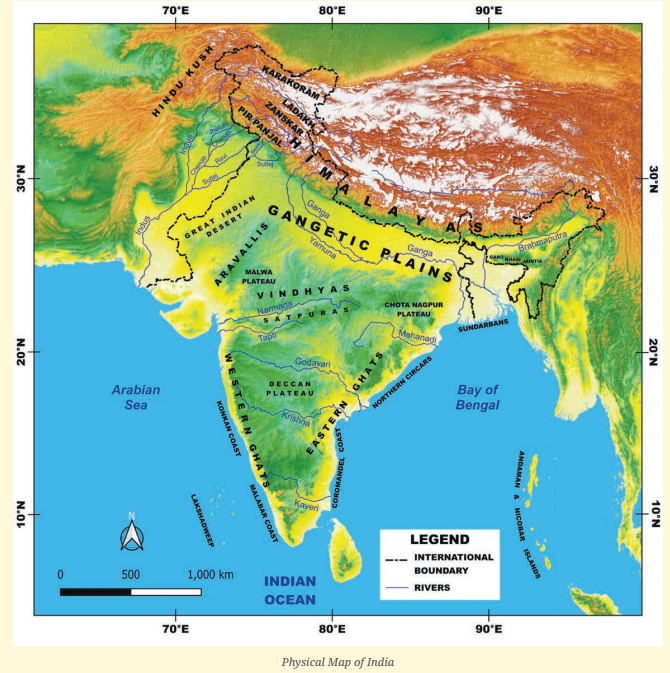
Answer:
Yes, we have seen or read about floods. It occurs frequently during the monsoon.
There are the following reasons for flood occurrence in the area, such as Uttar Pradesh, Bihar, Kerala, Andhra Pradesh and Assam :
Reasons for Floods in Uttar Pradesh: Overflow of rivers and heavy rainfall during the monsoon season.
Reasons for Floods in Bihar:Poor
drainage systems and Overflow of rivers.
Reasons for Floods in Kerala: Heavy rainfall.
Reasons for Floods in Andhra Pradesh: Cyclonic activity and monsoonal rains.
Reasons for Floods in Assam: Change in the course of river during rainy season and deforestation rapidly.
LET’S EXPLORE (Page 62)
Question 1.
Observe fig. Describe the effects they may have on people, plants, animals and economic life.
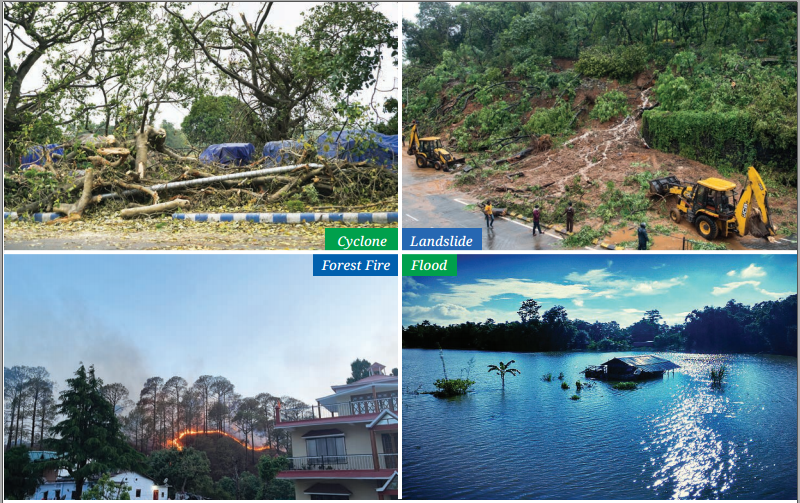
Answer:
The effects are the following :
- Many Life in such areas are at risk and many a time a huge loss is noticed.
- Mostly vegetation and wildlife also suffer from these disasters.
- Most of the money has been spent on restructuring or restoring the situation after such a disaster.
Question 2.
In groups of four or five, identify in each of the above disasters the part of natural causes ‘ and the part of human causes. Compare your conclusions.
Answer:
| Events | Natural Causes | Human Causes |
| Cyclone | Rise in temperature of ocean. Atmospheric conditions such as the creation of lowpressure areas in a particular region. | Urbanisation at a high level. Emission of gases responsible for greenhouse events. Result- Change in pattern of climate. |
| Landslide | Heavy and continuous rainfall. Seismic activities, such as earthquakes. Volcanic eruptions. | Vegetation removal due to deforestation. Unplanned and Unapproved construction activities in hilly areas. |
| Forest Fire | Strike lightning on dense forests. Rise in temperature. | Use of inflammable items. Use of land clearing practices. |
| Flood | Heavy and continuous rainfall. Glacier melting. Cyclonic activity. | Urbanisation. Illegal encroachment on the floodplains. Deforestation. |
Question 3.
Discuss in the same groups series of preventive measures that could help avoid the above disasters.
Answer:
Preventive measures are the following :
- Develop a strong and effective Early
Warning System
- Promote land-use planning
- Run awareness campaign
- Participate in the mitigation programme
Class 7 Climates of India Question Answer
Questions and Activities (Page 65-66)
Question 1.
Match the climatic factors with their effects:
| Column A | Column B |
| 1. Latitude | (a) Brings were air to India during summer |
| 2. Altitude | (b) Creates different climates in the north and south |
| 3. Proximity to the ocean | (c) Keeps higher places cooler |
| 4. Monsoon winds | (d) Moderates the temperature |
Answer:
| Column A | Column B |
| 1. Latitude | (b) Creates different climates in the north and south |
| 2. Altitude | (c) Keeps higher places cooler |
| 3. Proximity to the ocean | (d) Moderates the temperature |
| 4. Monsoon winds | (a) Brings were air to India during summer |
Question 2.
Answer the following questions:
(a) What is the difference between weather and climate?
Answer:
The differences between weather and climate are the following:
| Weather | Climate |
| 1. It is a state of the atmosphere at a particular place and time. | (a) It is the long-term average of weather in an area. |
| 2. It is a long-term pattern in a particular region | (b) It is a short-term atmospheric condition in a particular region. It may vary from time to time. |
| 3. It is generally stable i.e. It takes over longer periods to alter. | (c) It is not stable i.e., It varies from time to time. |
(b) Why do places near the ocean have milder temperatures than places far away from it?
Answer:
This is because the sea acts as a moderator for the temperature.
(c) What role do monsoon winds play in affecting India’s climate?
Answer:
The monsoon winds play a crucial role in affecting India’s climate are as follows :
- The monsoon winds bring the Maximum rainfall in India in the summer season and bring rainfall in east and south India in winter.
- The monsoon winds lower the temperature across the country.
- The monsoon winds support the biodiversity which also affects the climate of India.
(d) Why is Chennai warm or hot throughout the year, while Leh is cold?
Answer:
Chennai is warm or hot throughout the year, while Leh is cold can be understood by the following points :
Case-I
Chennai
- It is located on the south-eastern coast of India and close to the equator.
- It receives consistent sunlight throughout the year and has high humidity.
Case-II
Leh
- It is located at high altitude in northern India.
- It hardly receives sunlight and has nominal humidity
Question 3.
Look at a map of India given at the end of this book. Identify the climate for these cities — Leh, Chennai, Delhi, Panaji and Jaipur.
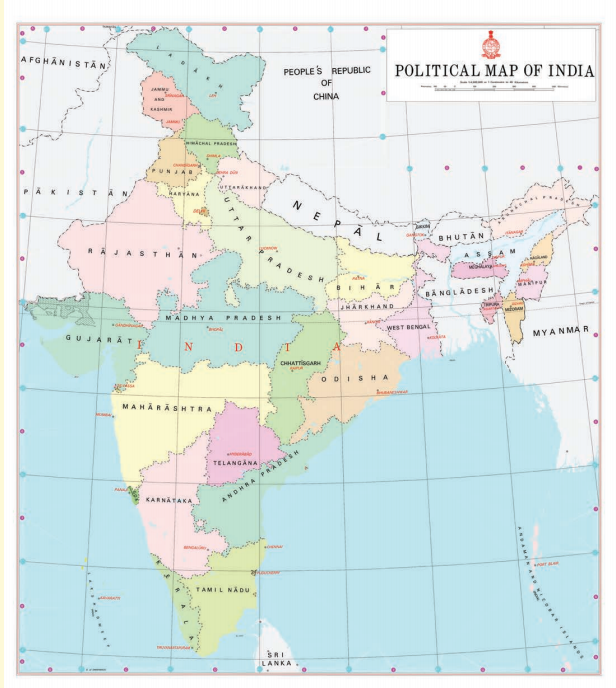
Is the place near the sea, in the mountains, or in the desert?
Answer:
Leh: In the mountains
Chennai: near the sea
Delhi: Plains
Panaji: Near the sea
Jaipur: In the desert (Close to the Thar Desert)
How do these factors affect the climate there?
Answer:
In the case of Leh
- Leh is located at a high altitude in the Himalayan Mountains. It is extremely cold.
In the case of Chennai
- Chennai is located near the sea. The sea acts as a moderator for the temperature. But due to closeness to the equator. The climate is hot and humid here.
In the case of Delhi
- Delhi is located in the plains. So it experiences hot in summer, cold in winter and rain in monsoon season.
In the case of Panaji
- Panaji is located near the sea. It has a warm and humid climate because of its proximity to the sea.
In the case of Jaipur
- Jaipur is located near the desert. It is hot in summer and cooler in winter.
Question 4.
Draw the monsoon cycle in summers and winters on a map of India.
- Label where the winds blow in summer and winter
- Show the direction of winds during the monsoon
Answer:
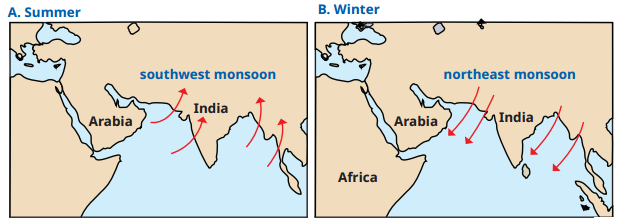
- Summer Monsoon (June to September): Winds blow from the southwest (from the Indian Ocean) bringing moisture and rain to India. The rains start in the southern tip and move northward, covering the entire subcontinent by mid-July.
- Winter Monsoon (October to February): Winds everse and blow from land to the sea, bringing dry weather and cool temperatures. These winds bring some moisture to parts of East and South India.
Question 5.
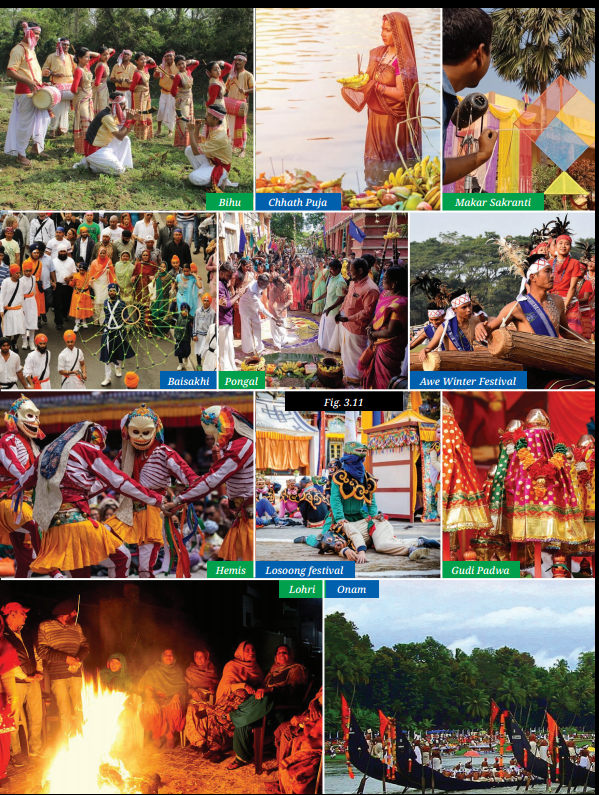
Make a colourful poster showing festivals in India linked to farming and weather (e.gBaisakhi, Onam). Add pictures or drawings of these festivals.
Answer:
Instructions for students :
Create a poster with images or drawings of festivals such as :
- Baisakhi (celebrating the harvest of wheat in Punjab).
- Onam (celebrating the rice harvest in Kerala).
- Pongal (harvest festival in Tamil Nadu).
Include images of farmers, crops and celebrations such as dances and traditional food associated with these festivals.
Here is the sample poster :
Question 6.
Imagine you are a farmer in India. Write a short diary entry about how you woul prepare for the rainy season.
Answer:
Diary Entry
May 5, 2025
Tuesday 09:30 p.m.
Dear Diary
It is cloudy weather today. Winds are full of moisture. I was, indeed, very happy. I immediately visited mv field and checked how good the soil was to sow. I found the soil is ready.
I went to the market and bought HYV seeds for rice, organic fertilizers and some other supplements for the field.
I sat near the field with my villagers and looked at the sky with a hope for a good harvest.
Would that the first rain brings happiness not only for me but for all-the farmers who always struggle for their survival.
Finally, whatever the things may be, I was ready to face them with full faith and determination.
Yours sincerely,
A farmer of India
Question 7.
Identify a natural disaster (e.g., cyclone, flood, landslide, or forest fire) and write a short essay that includes the causes and impacts. Suggest actions that individuals, communities and the ‘ government can take to reduce the impact.
Answer:
Short essays on the topics: Cyclones, Floods and Landslides are given below :
CYCLONE
Cyclones are very powerful natural disasters. It can be seen over the sea. It causes a great loss of life and property.
Causes of Cyclone
- The main cause of cyclones is the rise in temperature of both air and water than the normal and low-pressure area develop.
- The forces also work along with that in the origination of cyclones.
Impacts of Cyclone
- Environmental degradation
- Great loss of life and property Suggestions
- Monitoring the weather and hearing forecast time to time.
- Start a training programme for communities to manage such disasters.
- Government should enhance the early warning systems
FLOOD
Flood is the most common natural disaster that might be seen in various places in India from time to time. During the flood, many lives and property are lost.
Causes of Flood
- The most common cause of flood is the overflow of water from the banks of rivers mainly in the monsoon season.
- The melting of glaciers is further the cause of flooding.
- The poor structure of the drainage like sewerage, drains etc.
Impacts of Flood
- Loss of life and property.
- Environmental degradation.
Suggestions
- Monitoring the weather and hearing farecasts from time to time.
- Awareness about this natural disaster.
- The government should construct the dams and channels and manage to maintain the drainage system.
LANDSLIDE
A landslide is a natural disaster that takes place in hilly regions. In this, sudden movements of rock, soil and debris down. During this, many lives and property are lost.
Causes of Landslide
- Heavy rainfall is the common cause of landslides which is heard in news or articles published.
- Earthquakes and volcanoes are also the major causes.
Impacts of Landslide
- Loss of life and property.
Suggestions
- Plant deep-rooted vegetation on the slope of hills.
- Aware and report to concerned authorities if any person notices such condition.
- Follow the government norms during construction.
- The government should make a strict law for defaulters.
Exploring Society India and Beyond Class 7 Solutions
More from Class 7
- Banks and the Magic of Finance Class 7 Extra Questions and Answers SST Part 2 Chapter 8
- Infrastructure: Engine of India’s Development Class 7 Extra Questions and Answers SST Part 2 Chapter 7
- The State, the Government, and You Class 7 Extra Questions and Answers SST Part 2 Chapter 6
- India, a Home to Many Class 7 Extra Questions and Answers SST Part 2 Chapter 5
- Turning Tides: 11th and 12th Centuries Class 7 Extra Questions and Answers SST Part 2 Chapter 4
- Empires and Kingdoms: 6th to 10th Centuries Class 7 Extra Questions and Answers SST Part 2 Chapter 3
More in Social Science
- Banks and the Magic of Finance Class 7 Extra Questions and Answers SST Part 2 Chapter 8
- Infrastructure: Engine of India’s Development Class 7 Extra Questions and Answers SST Part 2 Chapter 7
- The State, the Government, and You Class 7 Extra Questions and Answers SST Part 2 Chapter 6
- India, a Home to Many Class 7 Extra Questions and Answers SST Part 2 Chapter 5
- Turning Tides: 11th and 12th Centuries Class 7 Extra Questions and Answers SST Part 2 Chapter 4
- Empires and Kingdoms: 6th to 10th Centuries Class 7 Extra Questions and Answers SST Part 2 Chapter 3