Empires and Kingdoms 6th to 10th Centuries Class 7 Question Answer SST Part 2 Chapter 3
Empires and Kingdoms 6th to 10th Centuries Class 7 Questions and Answers
Class 7 SST Part 2 Chapter 3 Question Answer
The Big Questions (Page 61)
Question 1.
What major changes characterised this period?
Answer:
This period saw the large empires like the Guptas declined. Many regional kingdoms rose across India. Powerful dynasties like the Palas, Gurjara-Pratiharas, Rashtrakutas, Chalukyas, Pallavas and Cholas expanded their territories. Power became decentralised, with smaller rulers. Important developments took place in art, temple building, literature, mathematics and astronomy flourished. Trade and cultural activities increased in different regions.
Question 2.
How did the political, cultural, and religious developments shape India during this period?
Answer:
Political, cultural, and religious developments during India's medieval period intertwined to form new kingdoms, foster artistic growth, and deepen spiritual practices, with rulers using alliances and warfare (political) to expand, while trade and religious travel spurred new ideas and cultural fusion, seen in temple architecture and literature, reflecting a dynamic society shaped by regional powers' and evolving beliefs (religious/cultural).
The fragmentation of larger empires led to the emergence of powerful regional kingdoms such as Palas, Pratiharas, Rashtrakutas, Chaulukyas, and Cholas. These kingdoms built powerful administrations, fought wars for territory, and improved local governance. Great univerisies like nalanda and Vikramashila flourished, while Sanskrit works. Monumental temples at Ellora and mamallapuram showed artistic and architectural growth.
The Bhakti and Sufi Movements emphasized a personal, loving relationship with God, making religion accessible to all. They challenged rigid caste hierarchies and ritualistic practices, preaching equality and social reform.The developments together strengthened India’s identity, economy, and cultural heritage.
Class 7 Social Science Part 2 Chapter 3 Question Answer
Question 3.
What was the impact of foreign invasions and interactions on Indian society and polity during this period?
Answer:
Foreign invasions and interactions brought both challenges and changes on Indian society. The Hunas weakened the Gupta Empire but later merged into Indian society. Arabs conquered Sindh but had limited control in India. Indian rulers strongly resisted Arab invasions. Indian culture remained strong despite invasions. Trade and exchange of ideas with foreign lands increased.
Let’s Explore
Question 1.
Do you recall where the capital of the earlier Maury a aiuj Gupta empires was located? (Page 64)
Answer:
The capital city for both the Maurya and Gupta empires was Pataliputra. This ancient city is located near the modern-day city of Patna, the capital of the state of Bihar in India.
Question 2.
How do you think this shift may have shaped the sub-continent’s politics in the years to come? (Page 64)
Answer:
After the decline of the Gupta Empire (around the 6th century CE), the shift of power gradually shifted westward from Pataliputra to Kannauj. This transition shaped subcontinent politics in several key ways:
Rise of Regional Sovereignty: The decline of Pataliputra as a central authority led to a power vacuum, allowing regional kingdoms like the Palas, Pratiharas, and Rashtrakutas to emerge.
The “Tripartite Struggle”: Kannauj became the new symbol of sovereignty. For centuries, major powers fought for control over it, marking a shift from a single pan- Indian empire to a period of intense rivalry between competing regional dynasties.
Geopolitical Focus: Moving the center of power further west toward the Ganga- Yamuna doab allowed subsequent rulers to better monitor and respond to external threats from the northwest frontiers.
Question 3.
If you know the Devanagari script, with the help of your teacher try to identify some of the letters in Harsha’s signature. (Page 64)
Answer:
The signature reads in Sanskrit as:
स्वहस्तो मम महाराजाधिराज श्री हर्षस्य
(Svahasto mama maharajadhiraja sri harsasya)
Translation: “By my own hand, Maharajadhiraja (King of Kings) Shri Harsha”. Some of the Devanagari letters in signature are:
ह, मु, र, ज, स, श्री, त
Question 4.
Looking at the map, can you identify a few mountain passes or desert areas that Xuanzang had to cross while travelling between China and India? (Page 66)
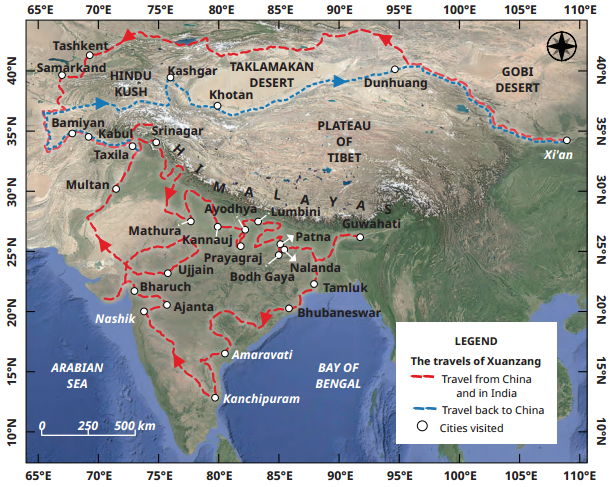
Fig. 3.7. Xuanzang’s route from China to India and back. (In this map, we have used modern names for the cities Xuanzang passed through.)
Answer:
Xuanzang crossed vast, challenging landscapes like the Gobi Desert, Taklamakan Desert,
- Gobi Desert and Turpan Oasis: Early challenges leaving China.
- Taklamakan Desert (Tarim Basin): Navigated oasis towns like Kucha, Karashar, and Khotan.
Key Mountain Ranges and Passes:
- Pamirs and Hindu Kush: Extremely treacherous high-altitude crossings.
- Khyber Pass: The famous gateway into India from Afghanistan/Central Asia.
Question 5.
Can you also identify a few important Buddhist centres of learning that Xuanzang visited in India? Do you know something of their significance? (Page 66)
Answer:
Xuanzang (Hsuan Tsang), the famous Chinese Buddhist monk, travelled extensively across India in the 7th century CE. He visited several major Buddhist centres of learning and wrote about them in great detail in his travelogue "Great Tang Records on the Western Regions."
Some important centres and it's significance, he visited:
- Nalanda — International Buddhist university; advanced scholarship.
- Lumbini — Birthplace of the Buddha; important pilgrimage site.
- Ajanta — Famous Buddhist cave monasteries, known for paintings and learning.
- Bodh Gaya — Spiritual heart of Buddhism; enlightenment site.
- Taxila — Early multi-disciplinary education; precursor to later Buddhist universities.
Question 6.
Why was Kannauj so attractive to those powerful dynasties? Observe its location on the map given below and discuss in class. (Page 68)
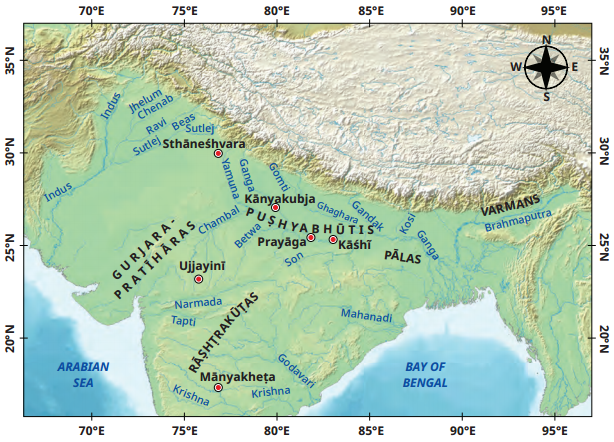
Fig. 3.3. A simplifid map of a few dynasties in north and peninsular India from the 7th century onward.
Answer:
Kannauj was a highly attractive target for powerful dynasties due to a combination of its strategic location, immense economic potential, and significant political and symbolic prestige in early medieval India. The desire to control the city led to a two- century-long “Tripartite Struggle” between the Gurjara-Pratiharas, the Palas, and the Rashtrakutas.
Question 7.
What qualities does Kalhana think a historian should have? (Page 74)
Answer:
Kalhana believed an ideal historian) should possess several critical qualities, primarily unbiased judgment, thorough research, and the ability to present a clear and comprehensive narrative. He also felt that history should teach moral lessons, showing how rulers prosper while cruel rulers and their families perish.
Question 8.
What do these lines reveal about his method of gathering information? In what ways does it resemble or differ from the way history is currently written? (Page 74)
Answer:
These lines from the introduction of the Rajatarangini (c. 1148-1149 C.E.) reveal that Kalhana employed a critical and multi-disciplinary methodology for gathering information.
Comparison with Modern History Writing
Kalhana’s method is often cited as the first "scientific" or "modern" historical work in ancient India due to its distinct similarities and differences with current practices.
Question 9.
Kalhana also writes, “That noble-minded poet is alone worthy of praise whose words, like that of a judge, remain free from love or hatred in relating the facts of the past.” What does he mean by ‘free from love or hatred’? How would meeting this condition make a historian more reliable? (Page 74)
Answer:
These lines means a historian must strive for objectivity and impartiality, setting aside personal biases, attachments, or animosities when recording historical events. This makes their work more reliable because readers can trust that the information is based on - evidence, not personal feelings.
Question 10.
Shankaracharya taught that brahman is the ultimate reality or the pure consciousness, and that the world as we perceive it is maya or illusion. He established four mathas (monasteries and centres of learning) at Badrinath, Puri, Dwarka, and Sringeri. Mark the location of these cities on a map; why do you think he chose four different corners of India rather than more central locations? (Page 75)
Answer:
Shankaracharya established the four mathas (monasteries and centers of learning) in the four corners of the Indian subcontinent as a deliberate and strategic effort to achieve both spiritual and national integration of the entire landmass. By placing them in the cardinal directions, he created a unified spiritual map of India (known as Bharatavarsha) and ensured the widespread propagation of the Advaita Vedanta philosophy.
Reasons for choosing the four corners Shankaracharya likely chose these peripheral, rather than central, locations for several strategic, spiritual, and unifying reasons:
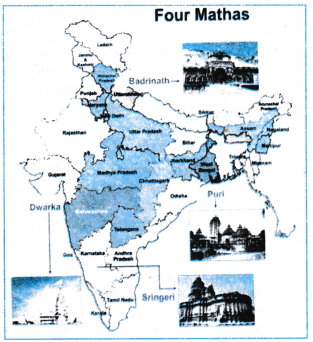
Geographical Integration and Cultural Unity: By placing institutions at the extreme north, south, east, and west, Shankaracharya sought to create a "spiritual boundary" that tied the entire subcontinent together under a unified cultural and philosophical vision, overcoming regional, linguistic, and cultural divides.
Revival and Propagation of Hinduism: During the 8th century, Vedic dharma faced challenges from other traditions. Establishing these hubs allowed for the dissemination of Advaita Vedanta (non-dualism) across the entire nation.
Spiritual Energy and Symbolism: These locations are often associated with sacred geography and natural, quiet surroundings ideal for intense meditation and spiritual training (e.g., the Himalayas in the north, the sea in the east and west).
Strategic Coverage: They served as command centers to maintain the purity of Vedic traditions and to ensure that the message of Advaita reached every corner of the country.
Question 11.
Note this panel’s highly dynamic three-dimensional composition, expressing Durga’s confident assault on the demon. Can you identify some of Durga’s many weapons? And her vahana? (Page 79)
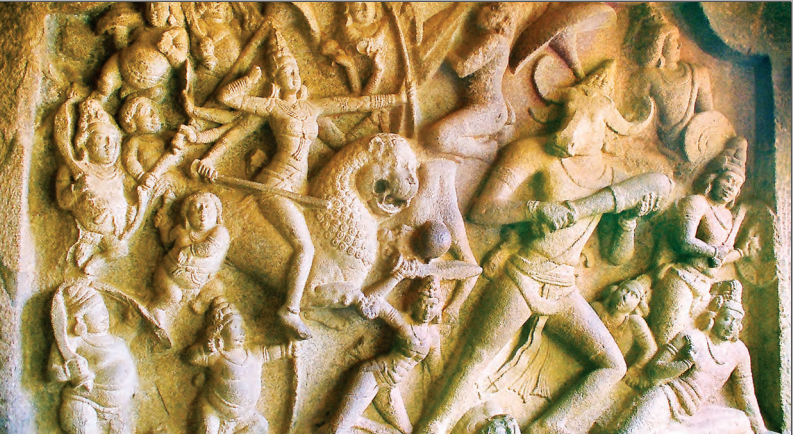
Fig. 3.18. A granite relief at Mamallapuram depicting goddess Durga about to slay the bufflo demon Mahishasura.
Answer:
Durga’s most prominent weapons include Trishula, chakra, khadga and khetaka(sword and shield) vajra,shankha and gada. Her divine vehicle (vahana) is a lion, which stands beside her.
Question 12.
What are the main differences between her attendants and the demon’s attendants? (Page 79)
Answer:
Nature and Appearance
- Her attendants (e.g., a goddess’s or heroine’s): Typically portrayed as benevolent, divine, or at least morally aligned with good. They often appear beautiful or in forms that inspire awe and respect (such as the Yoginis who are attendants of the warrior goddess Durga, or the animal companions of Momotaro).
- The demon’s attendants: Usually depicted as monstrous, fearsome, and malevolent creatures. They are described with terrifying features, such as gaping mouths, single eyes, or as snakes and frogs, designed to inspire fear and horror.
Behavior and Purpose
- Her attendants: Their actions usually support a righteous cause, such as helping the protagonist defeat evil, guiding a lost soul, or performing helpful tasks. They are often loyal and act with a clear purpose that serves the greater good or helps the community.
- The demon’s attendants: Their purpose is to cause trouble, guard ill-gotten treasure, or torment innocent people. Their behavior is generally chaotic, aggressive, . and destructive, mirroring the nature of their demonic master.
Question 13.
What does the demon’s slanted posture and general attitude indicate? (Page 79)
Answer:
The slanted posture and general attitude of the demon Mahishasura represent a critical moment of transition overall attitude indicate weakness, imbalance and defeat. The demon's attitude reflects the realization that his immense physical strength and the boons that protected him from men and gods are insufficient against the divine feminine power (Shakti).
Question 14.
What details do you observe in these coins? Why do the coins of Toramana and Skandagupta appear so similar? What conclusions can you draw? (Page 90)
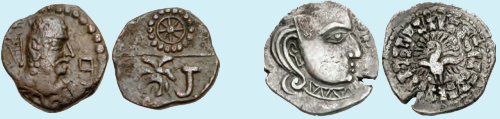
Fig. 3.26. (Left) A coin of the Hun a Toramana, with his name ‘Tora’in Brahmi script. (Right) A coin of the Gupta emperor Skandagupta.
Answer:
Assuming Fig. displays typical gold or silver coins of these rulers:
Both coins show the profile of the ruler's face on one side. On the other side, there are symbols and designs, such as a wheel or decorative marks. The coin of Toramana also has his name "Tora" written in Brahmi script. The coins look similar because the Huna rulers adopted the Gupta style of coin making. They copied the design, shape and symbols of Gupta coins to show power and legitimacy. By doing so, Toramana wanted to look like a rightful Indian king, just like the Guptas. These coins show that coin design was a way of showing authority. Foreign rulers like the Hunas used local Indian cultural symbols to gain acceptance. They wanted people to believe they were proper rulers, not outsiders.
Question 15.
The Chachnama records that when King Dahar was killed, his widowed queen put up a brave resistance, and when the situation became hopeless, she immolated herself along with other ladies. Another queen ordered her treasure to be distributed among the brave soldiers and inspired them to stand against the invaders. What does this suggest about the way the indigenous people responded to invasions? (Page 91)
Answer:
It suggests that the local people did not surrender easily. They fought bravely, resisted the invaders and continued to defend their land even after their king was killed.
Question 16.
Why do you think the queen chose to give away her treasure? (Page 91)
Answer:
The queen’s decision to distribute her treasure to the soldiers was a strategic and psychological move. Distributing wealth served as a powerful incentive to keep soldiers motivated and loyal. By distributing or destroying the treasure, the queen ensured it would not fall into the hands of the enemy as war booty. It signaled to the troops that the royal family was willing to sacrifice their personal assets for the collective survival and defense of the land. ^
Question 17.
What does this reveal about the role of (Page 91)
Answer:
These accounts challenge the notion of women that women were not passive or weak. Revealing their active and leadership roles during times of war.
Don't Miss Out
Question 1.
During this period, inscriptions began using both Sanskrit and regional languages simultaneously. In land grants, the ruler and his dynastic history were often praised in Sanskrit, while the operative details of the grant were recorded in the local language. Why do you think such inscriptions were written in two languages?
Answer:
Inscriptions were written in two languages to balance royal prestige with administrative practicality.
Think About It
Question 1.
Does the above ceremony remind you of a similar event discussed in Part 1 of this textbook? (Page 67)
Answer:
Yes, the ceremony described above reminds us of the Ashvamedha Yajna (Horse Sacrifice) discussed in Part 1 of the textbook because both were grand royal events connected to religion, prestige and power.
Question 2.
Al-Masudi, a 10th-century Arab historian and traveller from Baghdad, gave high praise to a Rashtrakuta ruler: “His troops and elephants are innumerable. ... There is none among the rulers of Sindh and Hind who in his territory respects the Muslims [as he does]. In his kingdom, Islam is honoured and protected. And; for them, mosques and congregational mosques, which are always full, have been built for offering prayers five times.”
What does this tell us about the Rashtrakutas? (Page 72)
Answer:
Al-Masudfs high praise of the 10th-century Ra$htrakuta ruler (often identified as Indra III or Amoghavarsha) provides significant insights into the nature of their empire and rule. The quote tells us the following about the Rashtrakutas:
- Immense Military power: Their military strength was exceptional, particularly with "innumerable" troops and a large, well-organized elephant corps. Al-Masudi described them as having the greatest army among Indian rulers, with elephants used for both war and specialized labor.
- Religious Tolerance and Secular Outlook: Despite being Hindu rulers, they fostered a, inclusive, secular, and tolerant environment, allowing Muslims to settle, practice their religion, and build mosques.
- Protection of Minorities: The Kingdom was known for its protection of religious minorities. Al-Masudi highlights that, unlike other regions, Islam was particularly honored, protected, and thriving within the kingdom.
- Diplomatic Relations and Trade: The presence of flourishing mosques and the respectful treatment of Muslims suggest robust economic ties and diplomatic relations with Arab merchants and the Abbasid Caliphate.
Question 3.
How does a professional group transform into a jati? (Page 85)
Answer:
A professional group becomes jati when people of same occupation start thinking themselves as a seprate community. Over time, they began to follow common customs, marry with in their grou;, pass their profession from onr generation to another and create their own rules. This makes the occupation -based group turn into a special group, or jati.
Question 4.
Sulaiman, a 9th-century Arab merchant and traveller, makes this comment on a Gurjara-Pratihara ruler: “This king maintains numerous forces, and no other Indian prince has so fine a cavalry. He is unfriendly to the Arabs ... there is no greater foe of the Muhammadan faith than he.... He has riches, and his camels and horses are numerous. ... There is no country in India safer from robbers.” Why do you think the author calls the ruler a ‘foe to the Muslim faith’? (Page 92)
Answer:
The author calls the ruler a "foe to the Muslim faith" because, in the eyes of the Arab traveller Sulaiman, the ruler strongly opposed the Arabs and stopped their advance in India. He had a large, powerful army and excellent cavalry, so the Arabs could not easily defeat him or spread their rule and religion in his region. Since he successfully blocked their expansion, Sulaiman saw him as the greatest enemy of the Muslims and their faith in India.
Question 5.
The table lists common everyday words, highlighting their similar pronunciation across the three languages. By comparing these sounds, you can identify words that are closely related or share common roots in all three languages. With the help of your teacher, use this observation to complete the table. (Page 93)
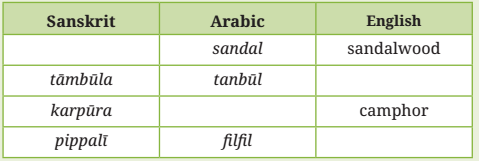
Answer:
Class 7 Empires and Kingdoms 6th to 10th Centuries Question Answer
Questions and Activities (Page 96)
Question 1.
If you lived in Kannauj during the 4 struggle between the Palas, the Pratlharas and the Rash(rakutas, how would it change your daily life and your estimate of the rulers? Write a letter on this to your friend living in Kanchipuram.
Answer:
Letter from Kannauj
Kannauj
Date: _____________
Dear Friend,
I hope you are doing well in Kanchipuram. Life in Kannauj has become very difficult these days. The Palas, Pratiharas and Rashtrakutas are always fighting to control our city. Because of this, there is fear and confusion everywhere.
Our daily life is disturbed. Markets close often, food becomes costly, and people are worried about safety. Many farmers and traders suffer as soldiers move through the city. Taxes are high to support the armies, and common people face many problems.
I feel the rulers care more about power than about the people. Though they are strong kings, their constant wars bring trouble to us. I wish they would live peacefully and think about the welfare of the people.
Please write back and tell me how life is in your city.
Your loving friend,
Question 2.
Emperors and kings during this period controlled only core regions and governed other regions through subordinate vassals. What would be the advantages and the challenges of such a system?
Answer:
Advantages
- Kings could control large areas easily.
- Local rulers knew regional problems well.
- Less pressure on central administration.
Challenges
- Vassals could become disloyal.
- Frequent rebellions weakened kingdoms.
- Central control was often unstable.
Question 3.
In what ways were the invasions of the Hunas and the Arabs different in their aims, methods, and impact on the Indian subcontinent? Prepare a write-up, discuss and present it in the class.
Answer:
The invasions of the Hunas (5th-6th century CE) and the Arabs (from the 7th century CE) in India differed in their aims, methods, and impact. The Hunas came mainly to plunder, attacking rapidly with cavalry and causing widespread destruction of cities and temples. The Arabs aimed to expand political and religious control. Hunas quickly adopted Indian culture. Arabs ruled Sindh but failed to expand much further. Arab impact was limited compared to other regions. The Hunas caused short-term disruption, weakening, the Gupta Empire and damaging the economy, while the Arabs left a longer-lasting impact through political control, trade and the spread of Islam. In short, the Hunas were mainly destructive conquerors, whereas the Arabs combined conquest with administration and cultural integration, creating lasting changes in northwest India.
Question 4.
Imagine you are a common citizen watching the Prayaga assembly. How would you react to Harsha giving away , most of his wealth?
Answer:
- I would feel amazed by his generosity.
- Poor people would feel grateful.
- It would show the king’s kindness and fairness.
- People would respect Harsha more.
- It would create unity among religions
Question 5.
Forming groups, let each group choose one Alvar and one Nayanar and prepare a biography poster or booklet. Include their life stories and a sample poem or two (in translation).
Answer:
Do it yourself with the help of teacher:
- Alvars and Nayanars - Group Activity (Sample Points)
- Alvars were devotees of Vishnu.
- Nayanars were devotees of Shiva.
- They preached devotion through songs.
- They used local languages, not Sanskrit.
- Their poems are still sung today.
Question 6.
You will notice that our maps show only ancient names for the kingdoms* capitals and main cities. Using a pencil, mark the modern names next to their original names. Refer the current map of India and try to locate those cities on it.
Answer:
To help you update your historical map, here is a guide to the modern names of key ancient Indian cities and capitals. In 2026, these locations correspond to the following thriving modern cities:
Northern & Central India
- Pataliputra: Modern-day Patna, Bihar.
- Indraprastha: Modern-day Delhi.
- Kashi / Varanasi: Still known as Varanasi, Uttar Pradesh.
- Prayag: Modern-day Prayagraj, Uttar Pradesh.
- Kanyakubja / Kanauj: Modern-day Kannauj, Uttar Pradesh.
- Ujjayini: Pradesh. Modern-day Ujjain, Madhya Pradesh.
- Saketa: Modern-day Ayodhya, Uttar Pradesh.
- Purushapura: Modern-day Peshawar, Pakistan.
- Takshashila: Modern-day Taxila, Pakistan (near Islamabad).
Western & Eastern India
- Pragjyotishpura: Modern-day Guwahati, Assam.
- Bhagyanagar: Modern-day Hyderabad, Telangana.
- Bharukachha / Bhrigukachha: Modern- day Bharuch, Gujarat.
- Dwaravati: Modern-day Dwarka, Gujarat.
- Champa: Located near modern-day Bhagalpur, Bihar.
- Rajgriha: Modern-day Rajgir, Bihar.
Southern India
- Madras: Now known as Chennai, Tamil Nadu.
- Manyakheta: Modern-day Malkhed (near Kalaburagi/Gulbarga), Karnataka.
- Kanchipuram: Still known as Kanchipuram, Tamil Nadu.
- Madurai: Still known as Madurai, Tamil Nadu.
- Pratishthana: Modern-day % Paithan,
Maharashtra.
- Tagara: Modern-day Ter (in Osmanabad district), Maharashtra.
Question 7.
Match the ruler or the dynasty with the city.
Answer:
(a) - (iii)
(b) - (iv)
(c) - (ii)
(d) - (v)
(e) - (i)
Exploring Society India and Beyond Class 7 Solutions
More from Class 7
- Banks and the Magic of Finance Class 7 Extra Questions and Answers SST Part 2 Chapter 8
- Infrastructure: Engine of India’s Development Class 7 Extra Questions and Answers SST Part 2 Chapter 7
- The State, the Government, and You Class 7 Extra Questions and Answers SST Part 2 Chapter 6
- India, a Home to Many Class 7 Extra Questions and Answers SST Part 2 Chapter 5
- Turning Tides: 11th and 12th Centuries Class 7 Extra Questions and Answers SST Part 2 Chapter 4
- Empires and Kingdoms: 6th to 10th Centuries Class 7 Extra Questions and Answers SST Part 2 Chapter 3
More in Social Science
- Banks and the Magic of Finance Class 7 Extra Questions and Answers SST Part 2 Chapter 8
- Infrastructure: Engine of India’s Development Class 7 Extra Questions and Answers SST Part 2 Chapter 7
- The State, the Government, and You Class 7 Extra Questions and Answers SST Part 2 Chapter 6
- India, a Home to Many Class 7 Extra Questions and Answers SST Part 2 Chapter 5
- Turning Tides: 11th and 12th Centuries Class 7 Extra Questions and Answers SST Part 2 Chapter 4
- Empires and Kingdoms: 6th to 10th Centuries Class 7 Extra Questions and Answers SST Part 2 Chapter 3