The Story of Indian Farming Class 7 Question Answer SST Part 2 Chapter 1
The Story of Indian Farming Class 7 Questions and Answers
Class 7 SST Part 2 Chapter 1 Question Answer
The Big Questions (Page 1)
Question 1.
What are the main characteristics of Indian agriculture?
Answer:
The main characteristics of Indian agriculture are:
(a) Indian agriculture is not limited to growing crops; it includes crop farming, animal rearing, fisheries, forestry, horticulture and livestock rearing.
(b) India has a wide range of climates and soils. This allows farmers to grow many crops—like rice in wetter regions, wheat in cooler areas and cotton, sugarcane, and millets in warmer places.
(c) Farming involves many activities like sowing, weeding and harvesting. These tasks give work to many people and strengthen rural communities.
(d) It uses a mix of traditional and modern methods. This combination helps to maintain cultural practices.
(e) A large part of India’s population depends on agriculture for livelihood. It contribute more than 18% to India’s GDP.
Question 2.
How are farming, climate, soil and water interrelated?
Answer:
Farming, climate, soil and water form a deeply interconnected system where climate decides temperature and rainfall needed for crops. For example rice grows well in warm areas with plenty of rain, while wheat grows best in cooler places with moderate rainfall. Thus, the climate of place guides farmes in choosing the right crops.
Soil type provides nutrients and support to plants when the soil is rich and healthy, crops grow better and give higher yields. Wherever the soil needs support, farmers, improve it using compost and fertilisers.
Water availability affects crop growth and yield. Crops need the right amount of water to grow and farmers use rivers, canals and tanks to irrigate their fields.
Therefore different crops grow where climate, soil, and water work together to decide what kind of farming is possible in any region. Farming depends on the balance of all three factors.
Class 7 Social Science Part 2 Chapter 1 Question Answer
Question 3.
How can traditional practices and contemporary ones complement each other?
Answer:
Traditional practices protects soil and nature, while modern methods increases production and save labour. Traditional knowledge helps in sustainable farming, modern technology improves irrigation and seed quality. Using both together ensures high yield and long-term farming. By combining both, farmers can grow healthier crops in a faster and safer way.
Let’S Explore
Question 1.
Create a list of the foods you typically eat. Identify the grains, pulses, oils, vegetables, and fruits in them. Now locate where you live on a physical map of India. (You may refer to the political map of India at the end of the book if you wish.) Which of the food items do you think grow in and around where you live? What do you think are the reasons that they are cultivated in your region? Which of them comes from other places? Why do you think they are not grown in your area? (Page 3)
Answer:
The foods I usually eat are:
- For Breakfast: Chilla, cornflakes, dal, poha, idli, eggs.
- For Lunch: Rice, dal, sabzi (potato, brinjal, beans), curd.
- For Snacks: Fruits (banana, apple), chana, biscuits.
- For Dinner: Rice/roti, vegetables, pulses. The following foods are made from:
Grains: Rice, Wheat (used to make roti), Poha (flattened rice), Idli (made from rice and lentils).
Pulses: Arhar dal, Moong dal, Chana (gram).
Oils: Mustard oil, Refined oil (sunflower/ soybean).
Vegetables: Potato, Brinjal, Beans, Lady’s finger, Tomato, Spinach, Cauliflower.
Fruits: Banana, Apple, Mango (seasonal), Guava.
(Suggested answer) I live in Darbhanga, which is located in north-central Bihar. Food items that grow in and around my area are:
- Rice, wheat, maize, chickpea, pigeon pea and foxtail millet is grown as the land is fertile and gets good rainfall.
- Fruits like litchi, banana, guava, mango - grow well in warm climates.These food items are cultivated in my area because of the following reasons:
- Fertile soil (alluvial soil in many areas)
- Good rainfall during monsoon
- Suitable temperature for rice, wheat and vegetables
- Plenty of water sources like rivers and ponds
- Traditional farming knowledge in the region The food items that come from other places are:
- Apples — usually come from Himachal Pradesh or Kashmir.
- Sunflower oil or soybean oil - produced in other states.
- Idli rice/dosa rice - often supplied from South India.
- They are not grown in my area because:
- Apples need a cold climate, which is not found in the plains.
- Sunflower and soybean grow better in drier regions like Maharashtra and Madhya Pradesh. Some crops need specific soil or water conditions that are not available locally.
Question 2.
Imagine that your state received less than normal monsoon rains for two consecutive years. Which items are likely to disappear from your meals, or are likely to become difficult to access? (Page 7)
Answer:
After two years of poor monsoons, staple crops like rice, pulses (dal), vegetables (especially seasonal greens like spinach, beans), and oilseeds would become scarce and expensive due to crop failure, while dairy and meat products (milk, paneer, chicken) would also be affected by animal fodder shortages, impacting availability and raising prices significantly, making them harder to afford or find regularly in daily meals.
Likely Disappearing/Scarce Items:
(a) Staple Grains (Kharif Crops): Rice, maize, millets (like jowar, bajra) are heavily monsoon-dependent and would see drastically reduced yields or crop failure.
(b) Pulses (Dal): Various lentils (arhar/tur, urad, moong) grown during the monsoon season would suffer significant losses.
(c) Vegetables & Fruits: Rain-fed seasonal produce like tomatoes, leafy greens, gourds, and fruits would be scarce and costly.
(d) Oilseeds: Groundnut (peanut) and soybean crops, also Kharif crops, would be heavily impacted.
(e) Dairy & Milk Products: Lack of rain means less fodder for cattle, reducing milk supply and increasing prices.
(f) Spices & Condiments: Many spices rely on monsoon moisture, leading to shortages.
Question 3.
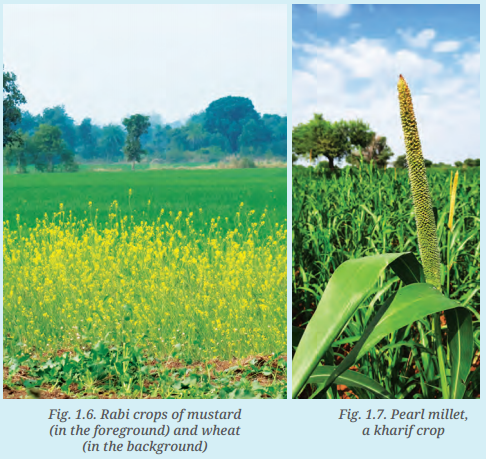
Prepare a list of the crops that are cultivated in your state or union territory in a year and classify them into kharif, rabi, and zaid. (Page 9)
Answer:
Cultivated in my area-classified into Kharif, Rabi and Zaid
1. Kharif (Monsoon/Autumn Crop)-June to October
| Type of Crop | Examples |
| Cereals | Rice (Paddy), Maize (Corn), Jowar (Sorghum), Bajra (Pearl Millet) |
| Pulses | Arhar (Tur), Moong (Green Gram), Urad (Black Gram) |
| Oilseeds | Groundnut, Soybean, Sesame (Til) |
| Cash Crops | Cotton, Jute |
| Vegetables | Brinjal, Tomato, Okra (lady’s finger), Pumpkin |
2. Rabi (Winter/Spring Crop)-November to April
| Type of Crop | Examples |
| Cereals | Wheat, Barley, Oat |
| Pulses | Gram (Chickpea), Masur (Lentil) |
| Oilseeds | Mustard, Rapeseed, Linseed |
| Vegetables | Potato, cauliflower, cabbage, spinach |
3. Zaid (Summer/Filler Crop)- March-JuneAnswer: Alluvial Soil
| Type of Crop | Examples |
| Fruits | Watermelon, Muskmelon |
| Vegetables | Cucumber, Pumpkin, Bitter Gourd, all leafy and seasonal vegetables |
| Fodder Crops | Jowar, Maize (used for fodder purposes) |
Question 4.
Try to name at least two states in each of the zones mentioned above. (Page 11)
Answer:
Alluvial Soil
- States: Uttar Pradesh, Bihar, West Bengal, Punjab, Assam, Haryana, coastal plains (TN, AP, Odisha).
- Key Areas: Northern Plains, river valleys (Ganga, Brahmaputra, deltas).
Black Soil (Regur)
- States: Maharashtra, Madhya Pradesh, Gujarat, Andhra Pradesh, Tamil Nadu, parts of Karnataka.
- Key Areas: Deccan Plateau (formed from basalt).
Red Soil
- States: Tamil Nadu, Karnataka, Andhra Pradesh, Odisha, Chhattisgarh, parts of Jharkhand, MP.
- Key Areas: Eastern and Southern parts of Deccan Plateau, weathering of crystalline rocks.
Laterite Soil
- States: Kerala, Karnataka, Maharashtra, Odisha, Assam, Meghalaya, Tamil Nadu.
- Key Areas: High rainfall hilly regions (Western Ghats, Eastern Ghats).
Desert (Arid) Soil
- States: Rajasthan, parts of Gujarat, Haryana, Punjab.
- Key Areas: Arid and semi-arid regions (Thar Desert, Aravalli foothills).
Mountain / Alpine Soil (Forest Soil)
States: Jammu and Kashmir, Himachal Pradesh, Uttarakhand, North-Eastern hilly states (Arunachal Pradesh, Nagaland, Manipur).
- Key Areas: Himalayan region, other mountainous and forest areas.
Question 5.
Which type of soil is predominantly found in your state or union territory? (Page 11)
Answer:
(Suggested answer) I live in Delhi. The type of soil predominantly found in the Union Territory of Delhi is Alluvial soil. Delhi is part of the extensive Indo-Gangetic plain, which is primarily composed of sediments deposited by rivers, especially the Yamuna.
Question 6.
Soils tell us stories about places — what might have happened over thousands of years during which the soils were being formed. Take a few samples of soil from your neighbourhood. Look carefully at them. (Examine the soil using a magnifying glass or microscope if you have access to either.) What do the samples consist of? What might be the origins of the soil? Are there signs of human activity that you notice? What might happen to the soil over time on account of this? (Page 11)
Answer:
Examining your local soil reveals its story through composition (sand, silt, clay, organic matter, rocks, roots), texture, color, and moisture, hinting at origins like weathered parent rock and decomposition, with roadside samples showing dust/pollution and garden soils revealing life, while human activity (litter, compacted layers) impacts its structure and water drainage, potentially harming plant growth over time.
(a) What do the samples consist of?
- Garden Soil (e.g., under a tree): Likely rich in dark, crumbly humus (decomposed leaves/plants), fine silt, small roots, maybe worms or insects, and possibly sand/clay depending on the parent material.
- Roadside/Paved Area Soil: Darker, dustier, possibly gritty with small stones, potentially littered with plastic bits or cigarette butts, less organic matter, and very compacted.
- Near Construction/Bare Ground: May contain crushed brick, concrete bits, or uniform sand/gravel, indicating disturbed earth.
(b) What might be the origins of the soil?
- Composition: The mix of sand, silt, and clay (texture) comes from the breakdown of parent rocks (like granite or sandstone) over millennia, plus organic additions.
- Color: Darker soils (more humus) suggest ancient forests; reddish hues might indicate iron oxides from weathered volcanic rocks.
- Location: Riverbank soil is often sandy and loose, while garden soil is enriched by decaying plants.
(c) Are there signs of human activity?
- Yes: Plastic, glass shards, concrete pieces, oil stains, or compacted layers (from foot traffic/vehicles) are clear signs.
- Subtle Signs: Uniformity (like in a manicured lawn) or lack of worms/ life indicates human management or disturbance.
(d) What might happen to the soil over time due to this activity?
- Compaction: Human/vehicle traffic squeezes soil, reducing air pockets, making it hard for roots to grow and water to drain, leading to runoff.
- Pollution: Litter breaks down slowly, potentially releasing toxins, while pollutants like oil can harm soil organisms and plant life.
- Erosion: Loss of plant cover (due to construction/pollution) leaves soil exposed, increasing wind and water erosion.
- Soil Degradation: Lack of organic matter and increased compaction reduces soil’s ability to hold water and nutrients, making it less fertile.
Question 7.
Take up a small group project. Identify the types of vegetables, fruits, and trees that grow in the different soil types.
(Page 11)
Answer:
Project Outline: Soil & Plant Match-Up
1. Identify Major Soil Types:
- Sandy Soil: Gritty, drains quickly, poor nutrient retention.
- Vegetables: Carrots, Radishes, Tomatoes, Spinach, Herbs (Thyme, Rosemary).
- Fruits: Strawberries.
- Trees/Shrubs: Hibiscus, some bulbs.
- Clay Soil: Fine particles, holds water, can get compacted, rich in minerals.
- Vegetables: Broccoli, Cauliflower, Kale, Peas, Potatoes, Cabbage, Brussels Sprouts.
- Fruits: Apples, Pears (with good drainage), some berries.
- Trees/Shrubs: Ornamental shrubs like
Aster, Flowering Quince.
1. Silty Soil: Smooth, holds moisture well, fertile.
2. Peaty Soil: Dark, spongy, acidic, retains lots of water, high in organic matter.
- Vegetables: Potatoes, Lettuce, Legumes, Onions.
- Fruits: Blueberries (acid-loving).
- Trees/Shrubs: Azaleas, Lantern Trees (acid- loving).
- Loamy Soil: Ideal mix of sand, silt, clay, and humus; fertile, good drainage & retention.
- Vegetables: Squash, Beans, Cucumber, Lettuce, Okra, Spinach, most root crops.
- Fruits: Apples, Pears, Strawberries, Citrus fruits.
- Trees: Many fruit trees, cotton, sugarcane (also good in black soil)
Question 8.
Create a family food flowchart that connects your favourite dishes to the different crops they are prepared from and the corresponding soil types in which they are cultivated. (Page 11)
Answer:
(Suggested answer) Family Food Flowchart
| Family Favorite Dish | Primary Crop | Ideal Soil Type | Key Soil Characteristics |
| Vegetable Pulao/Biryani | Rice | Clayey/Alluvial | High water retention |
| Roti/Chapati | Wheat | Loamy/Alluvial | Well-drained and fertile |
| Dal Tadka | Pulses (Lentils/Gram) | Loamy/Red Soil | Good aeration and moderate moisture |
| French Fries/Potato Mash | Potato | Sandy Loam/Red | Loose texture for root expansion |
| Nachos/Popcorn | Maize (Corn) | Alluvial/Loamy | Rich in nutrients and well-drained |
| Peanut Butter | Groundnut | Sandy/Red Soil | Light texture for underground pods |
| Jowar Roti | Sorghum (Jowar) | Black/Arid Soil | Moisture-retentive or drought-resistant |
| Hot Tea/Coffee | Tea/Coffee Leaves | Laterite/Mountain | Rich in iron and aluminum, acidic |
Question 9.
Identify modern agricultural solutions inspired by traditional practices (for example., neem-based practices). (Page 22)
Answer:
Modern agricultural solutions inspired by traditional practices combine ecological wisdom with scientific advancements to create sustainable, efficient, and resilient farming systems. Key innovations:
Neem-Coated Urea (NCU): A significant modern adaptation of the traditional Indian practice of mixing neem cake with fertilizer. It slows down the release of nitrogen from urea, reducing leaching and increasing Nitrogen Use Efficiency (NUE) by about 20% compared to ordinary urea.
Neem Cake Soil Conditioner: Using the residue of neem seeds after oil extraction to restore soil fertility, balance pH, improve soil structure, and control soil-borne pests like nematodes and root grubs.
Modern Rainwater Harvesting & Drip Irrigation: The age-old technique of storing water in tanks and tanks has been upgraded to efficient, automated drip systems with moisture sensors to reduce water use by 20¬60%.
Cover Cropping & Living Mulch: Traditional practices of covering soil, adapted into modern conservation tillage to prevent soil erosion, retain moisture, and suppress weeds using organic materials.
Question 10.
Listen to the special programmes for farmers on the radio or watch a programme on television for a few days. Write down carefully the information that is shared through these mediums. Make a short report on the categories of information you gathered as well as questions that came to your mind during this activity. (Page 25)
Answer:
Farmers’ radio/TV programs provide vital info on weather, market prices, new tech, government schemes etc. I watched Krishi darshan telecasted on DD Kisan channel, also on DD National. Following information I gathered
Crop Management & Techniques: Details on timely sowing, irrigation techniques (e.g., drip irrigation), soil health management, organic farming, and high-yielding varieties (HYV).
Market & Price Trends: Daily updates on local and national commodity prices (e.g., wheat, paddy, pulses), market demand, and best times to sell produce.
Weather Forecasts: Short-term and seasonal weather predictions to help farmers plan planting, irrigation, and harvesting.
Government Schemes & Policies: Information on schemes like PM-KISAN (financial aid), crop insurance (e.g., Fasal Bima Yojana), and subsidies for equipment.
Pest & Disease Control: Identification of common pests and diseases, and recommended biological and chemical control measures, often featuring expert Q&A.
Animal Husbandry: Advice on dairy farming, fodder management, and livestock health.
Questions That Came to Mind
- Local Relevance: “How applicable are these techniques (e.g., specific HYV seeds) in my district’s unique agro-climatic zone?”.
- Cost-Benefit: “What is the actual cost- benefit ratio for adopting the new organic fertilizer or drip irrigation system?”.
- Scheme Accessibility: “What are the exact, simple steps for a small farmer to register for the PM-KISAN scheme or crop insurance?”.
- Pest Resistance: “If a recommended pesticide fails, what are the alternatives for managing resistant pests?”.
- Water Management: “Specific advice for water-scarce regions on efficient water use beyond just drip irrigation.
Think About It (Page 2)
Question 1.
When you read or hear the word ‘farmer’, what do you visualise?
Answer:
When I hear or read the word ‘farmer’, I visualize a person engaged in the essential work of agriculture. This visualization typically incorporates several common elements and themes.
Don’t Miss Out (Page 10)
Question 1.
The Arthashastra contains sections on agriculture, including the preparation of land and seeds, as well as payment to farmers and other relevant topics. “A good rainy season is one when one- third of the annual rainfall occurs at the beginning (Shravana — July-August) and at the end of the season (Kartika — October-November), and two-thirds in the middle (Praushthapada — August- September and Ashvayuja — September- October).” Why do you think this statement was made? (Hint: Did it have anything to do with the crop cycle?)
Answer:
This detailed description of rainfall in the Arthashastra was made to ensure optimal agricultural yield and water management for the Kharif (monsoon) crop cycle. By specifying that one-third of the rain should fall at the beginning, two-thirds in the middle, and one- third at the end, Kautilya provided a model for “even” or balanced rainfall that supports different stages of crop growth.
Here is how it relates to the crop cycle:
Beginning (Shravana — July-August): The first one-third of the rain is crucial for softening the land for plowing, seed germination, and the initial sowing of crops like rice and millet.
Middle (Praushthapada & Ashvayuja — Aug-Oct): The two-thirds in the middle provide maximum water during the peak vegetative growth phase of the crops.
End (Kartika — Oct-Nov): The final one- third ensures the crops get enough water during the grain-filling stage, preventing premature drought.
This, in essence, was an ancient agricultural, economic, and meteorological strategy to predict yields, determine the appropriate time to sow specific crops, and manage agricultural tax (since good rain meant a good harvest).
Class 7 The Story of Indian Farming Question Answer
Questions and Activities (Page 27-28)
Question 1.
Why do farmers in Kerala grow rice while farmers in Punjab grow mostly wheat? What would happen if they swapped?
Answer:
Farmers in Kerala and Punjab grow different primary crops due to contrasting climatic and geographical requirements. They are botanical equivalent of “right crop at right home”. Each crop has its own favourite climate, soil and water needs.
Rice is a tropical crop that require high temperatures, abundant rainfall and loamy soils all this matches kerala’s climate. Where as Punjab, cool season provide the necessary cool growing season, followed by bright sunshine for ripening. Punjab’s well-drained alluvial soils and controlled irrigation systems more suitable for wheat growing.
- Swap Problem (Kerala): If Kerala tried to grow wheat, the climate would be too hot, and the heavy monsoon rains would ruin the crop.
- Swap Problem (Punjab): If Punjab tried to grow rice in winter, the temperatures would be too cold, and it lacks the high natural water supply required for rice.
- Conclusion: The choice of crop depends on the local climate, water availability, and the season. It is a reminder that agriculture is basically ecological match making and when the partners fit, the harvest sings.
Question 2.
Match the following:
| Column A | Column B |
| (a) Kharif crops | (i) Crops during the winter |
| (b) Rabi crops | (ii) Crops grown during the monsoon |
| (c) Alluvial soil | (iii) Thin, rough, and rocky soil found in mountainous regions |
| (d) Terrace farming | (iv) Crops grown in summer |
| (e) Alpine soil | (v) Soil rich in nutrients deposited by rivers |
| (f) Zaid crops | (vi) Method of farming on hillsides |
Answer:
(a) - (ii)
(b) - (i)
(c) - (v)
(d) - (vi)
(e) - (iii)
(f) - (iv)
Question 3.
Why do certain crops thrive in specific regions?
Answer:
Crops thrive in specific regions due to a combination of climate (temperature, rain, sun), soil type (nutrients, texture, pH), and topography (hills, plains) that match their unique needs, alongside factors like water availability, local traditions, market demand, and even government policies.
Key Factors
Climate: Each crop has ideal temperature, rainfall, humidity, and sunlight requirements; rice needs warmth and water, wheat needs cooler temperature.
Soil: Variations in soil composition (black, alluvial, sandy) and fertility suit different plants; cotton loves black soil, tea needs acidic, well-drained soil.
Topography: Flat plains suit large-scale crops like wheat and rice, while hilly slopes are perfect for tea and coffee, affecting drainage and mechanization.
Water Availability: Water-intensive crops like sugarcane grow where water is abundant, while drought-resistant millets grow in arid areas.
Cultural & Economic Factors: Local farming traditions, consumer demand, transport, and profitability influence crop choices.
Length of Growing Season: Regions with longer frost-free periods can support crops that need more time to mature.
Examples
- Rice: Warm, wet climates with abundant water (Asia).
- Wheat: Moderate, cooler climates with less water (temperate zones).
- Cotton: Black, clayey soils (India, USA).
- Tea & Coffee: Hilly, well-drained soils (India, Sri Lanka, South America).
Question 4.
How has modern technology helped farmers?
Answer:
Adopting new advance modern technology have helped farmers to increase productivity and reduce costs.
(a) Farmers use GenAI and chatbots (like India’s Kisan e-Mitra) to get instant, multilingual answers to farming challenges and government scheme queries.
(b) Modern techniques such as terracing are used in hilly areas to create flat steps for farming, which slows down water runoff and reduces soil erosion.
(c) Modern irrigation techniques drip and sprinkler irrigation help in using water more efficiently as using these new methods are very necessary as in india, ground water reserves are fast decreasing.
(d) Contemporary agriculture is characterised by modern farming methods that use technology, machinery, and new farming techniques. A significant turning point was the Green Revolution.
Question 5.
Why is sustainable agriculture important? Write a short note on this.
Answer:
Sustainable agriculture works with nature rather than against it, seeking to maximize food production while minimizing environmental impact. This approach involves preserving the environment, expanding natural resources, and creating a better life for animals and humans, ensuring the long-term sustainability of food sources while reducing reliance on standard farming practices and providing alternative food options.
Sustainable agriculture practices include using local resources, reducing water usage, and using natural fertilizers to maintain soil quality and reduce erosion, protecting natural resources for future generations. With the growing population and its need for more food, we must practice farming in environmentally responsible ways. Sustainable agriculture helps to preserve natural resources while promoting social equity and economic profitability.
Question 6.
Name some challenges that farmers face today. What might be their impact for people?
Answer:
Farmers all over the world are plagued by several issues. These problems indirectly and directly affect the farmer’s life. Furthermore, farming practices and other aspects of agriculture can take up resources and time. Some of the challenges that today’s farmers are facing;
(a) Climate change: Unseasonal rains, long dry spells, sudden hailstorms—all thanks to climate change—are wreaking havoc on farming schedules. Crops that once flourished under predictable monsoons are now either drying out or getting washed away.
(b) Soil depletion - Land is losing its life: When the soil is tired, even the best seeds can’t do magic. Years of continuous farming without proper rest or soil treatment has led to a drastic reduction in soil fertility. Overuse of chemical fertilisers has further poisoned our lands, making them less productive each season.
(c) Water Woes - Too little or Too much:
We all know how crucial water is in farming. Yet, most farmers today face either drought or waterlogging.
(d) Pests and Diseases: Increased pressure from new and existing pests and crop diseases.
(e) Operational Hurdles: Labor shortages, inadequate storage, poor market access, small landholdings, and difficulty adopting new tech.
Impacts on People:
(a) Food Security and Price: Reduced yields mean less food, leading to higher grocery bills and potential shortages, especially for vulnerable populations.
(b) Nutrition and Quality: Farmers may cut corners on quality or shift away from diverse crops due to costs, affecting public health.
(c) Rural Economies: Farmer debt and instability impact rural communities, forcing young people to leave farming.
(d) Global Stability: Food crises can lead to social unrest and migration, affecting national and international security.
(e) Environmental Health: Unsustainable practices to cope can worsen pollution and climate change, affecting everyone.
Question 7.
Have a debate in class on the topic “Traditional irrigation methods are better than modern ones.”
Answer:
Debate: “Traditional irrigation methods are better than modern ones.” (Points for discussion)
For the motion
- Traditional methods save water and protect nature.
- Techniques like canals, tanks, wells use locally available resources and do not require expensive machinery.
- They are cheap and community-based.
Against the motion
- Modern methods increase crop production.
- Modern irrigation uses water efficiently and save water.
- Drip and sprinkler systems deliver water directly to plants and increases crop yield.
- Modern methods support higher productivity and meet the today’s agriculture needs.
Question 8.
Write a short essay describing what farming might be like when you are 60 years old. You could also draw / paint a picture to illustrate what you envision.
Answer:
When I turn 60, the landscape of farming will look profoundly different, blending the timeless necessity of cultivating the earth with advanced, sustainable technology. By then, farming will likely be a highly precise, data-driven, and autonomous profession, aimed at maximizing yields while protecting the planet’s resources.
I imagine waking up in a farmhouse that is not just a home, but a central command hub. Instead of walking into the fields to check crops, I will start my day by reviewing data on a tablet. Satellites and drones, equipped with multispectral cameras, will have spent the night monitoring crop health, soil moisture, and nutrient levels. Artificial Intelligence (AI) will provide a daily report, identifying exactly which rows need nutrients and which spots need water, enabling me to act with absolute precision.
The fields themselves will look different, likely employing vertical farming for certain crops to save space and water. Where traditional large-scale farming continues, it will be dominated by electric, autonomous, driverless tractors and robots that can work 24/7. These machines will be able to plant, weed, and harvest without direct human intervention, eliminating the physical exhaustion of manual labor. Weeding will no longer involve heavy chemicals; instead, robots will use computer vision to distinguish between crops and weeds, either removing them mechanically or using laser technology.
My role as a farmer at 60 will be less about manual tilling and more about managing these systems, interpreting the data, and ensuring a healthy, high-yield, and sustainable output for a growing global population. It will be a perfect, seamless harmony between nature and advanced technolog.
Question 9.
Form small groups and discuss the issues affecting the Ganga basin. Prepare a presentation proposing your solutions and their rationale (your reasons). Share and discuss in class. Your teacher will guide you in this exercise.
Answer:
For our groups project, we studied the Ganga basin and the problems it faces. The main issues include are:
(a) Low water levels due to overuse and climate change.
(b) Excess irrigation and dams disturb river flow.
(c) Pollution harms soil and crops deforestation along the riverbanks causing soil erosion, overfishing that reduces fish populations, and floods during heavy rains due to poor water management.
(d) Global warming reduces water flow because higher temperatures increase evaporation and melt glaciers faster.
Solutions: Save water, reduce pollution, . protect glaciers. This will help farmers and food production. Trees should be planted along the riverrbanks to prevent soil erosion, and fishing should be regulated to maintain healthy fish populations. Implementing these solutions will protect the Ganga and support the people, animals and plants that depend on it.
Question 10.
Looking at the crops listed in the section ‘Echoes from the Past’, which ones do you find in use in your home? What
conclusion can you draw from your observations?
Answer:
(a) Rice, wheat, pulses, and vegetables are still used.
(b) These crops were grown thousands of years ago.
(c) Ancient farming knowledge is still useful.
(d) Indian agriculture has strong continuity.
(e) Traditional crops remain important today.
Exploring Society India and Beyond Class 7 Solutions
More from Class 7
- Banks and the Magic of Finance Class 7 Extra Questions and Answers SST Part 2 Chapter 8
- Infrastructure: Engine of India’s Development Class 7 Extra Questions and Answers SST Part 2 Chapter 7
- The State, the Government, and You Class 7 Extra Questions and Answers SST Part 2 Chapter 6
- India, a Home to Many Class 7 Extra Questions and Answers SST Part 2 Chapter 5
- Turning Tides: 11th and 12th Centuries Class 7 Extra Questions and Answers SST Part 2 Chapter 4
- Empires and Kingdoms: 6th to 10th Centuries Class 7 Extra Questions and Answers SST Part 2 Chapter 3
More in Social Science
- Banks and the Magic of Finance Class 7 Extra Questions and Answers SST Part 2 Chapter 8
- Infrastructure: Engine of India’s Development Class 7 Extra Questions and Answers SST Part 2 Chapter 7
- The State, the Government, and You Class 7 Extra Questions and Answers SST Part 2 Chapter 6
- India, a Home to Many Class 7 Extra Questions and Answers SST Part 2 Chapter 5
- Turning Tides: 11th and 12th Centuries Class 7 Extra Questions and Answers SST Part 2 Chapter 4
- Empires and Kingdoms: 6th to 10th Centuries Class 7 Extra Questions and Answers SST Part 2 Chapter 3